
Fund Home Accessibility With a Reverse Mortgage
Use a reverse mortgage to fund wheelchair ramps, stairlifts, walk-in tubs, and accessible bathrooms. Costs, grants, tax credits, and a worked example for Ontario.
You can manage the stairs today, but your knees are getting worse. Your spouse uses a walker now, and the bathroom doorway is too narrow. The occupational therapist recommended a stairlift six months ago, and you have been putting it off because a quote for $8,500 is not in the budget. These are the quiet calculations that Ontario seniors make every day — weighing safety against cost, independence against affordability. A reverse mortgage can end that calculation entirely, providing $50,000 to $200,000 or more in tax-free funds specifically to make your home safe and accessible for the decades ahead, without a single monthly payment.
This article is for educational purposes only and does not constitute financial advice.
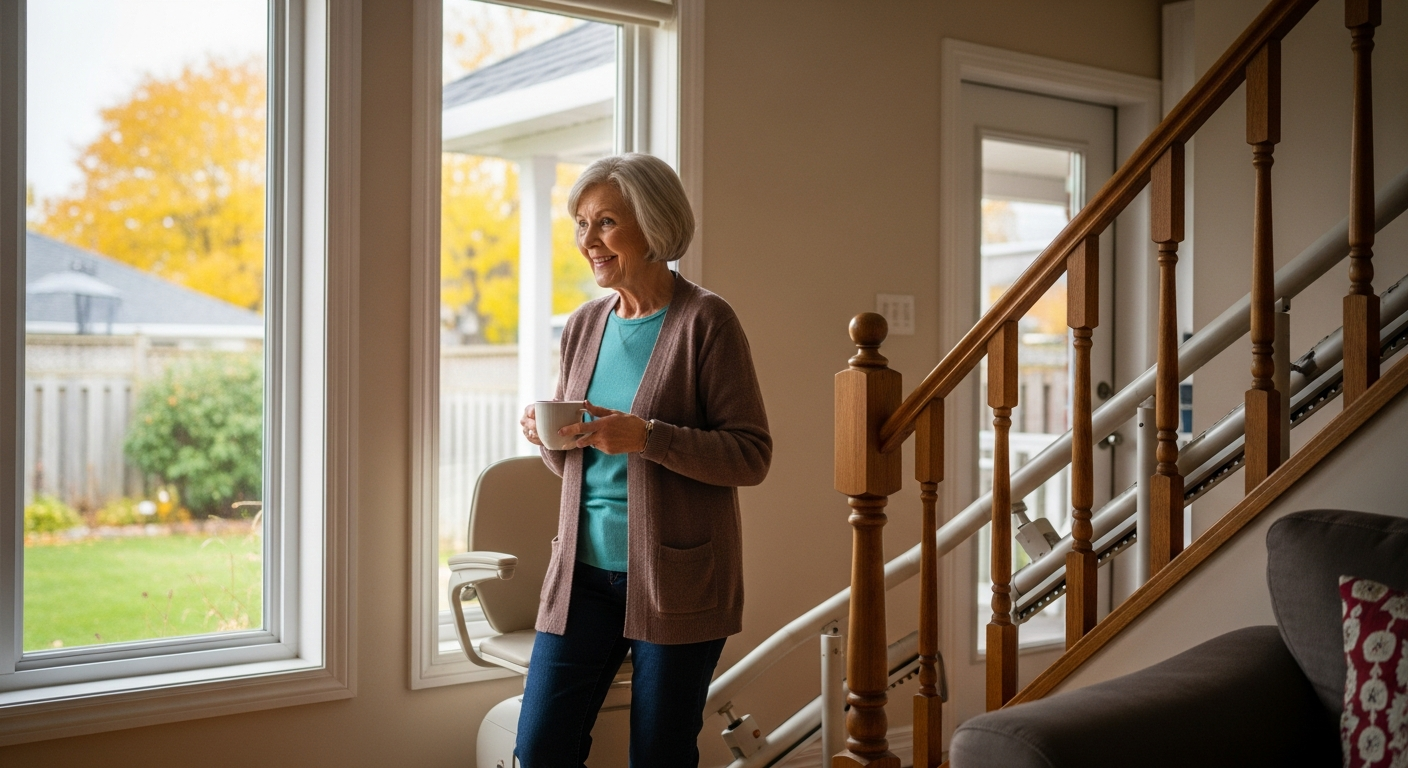
The Cost of Home Accessibility Modifications in Ontario
Home accessibility is not one project — it is a series of modifications that may be needed now or over the coming years. Understanding the costs helps you plan how much reverse mortgage funding to arrange.
| Modification | Typical Cost (Ontario, 2026) | Purpose |
|---|---|---|
| Wheelchair ramp (exterior) | $3,000–$8,000 | Safe entry/exit without steps |
| Stairlift (straight staircase) | $3,000–$6,000 | Navigate between floors without climbing |
| Stairlift (curved staircase) | $8,000–$12,000 | Custom track for angled or multi-landing stairs |
| Home elevator (residential) | $20,000–$50,000 | Full floor-to-floor access for wheelchairs and mobility devices |
| Walk-in tub | $5,000–$10,000 | Safe bathing with door entry, built-in seat |
| Walk-in shower conversion | $6,000–$15,000 | Replace tub with barrier-free shower, grab bars, seat |
| Wider doorways (per doorway) | $800–$2,500 | Wheelchair and walker clearance (36" minimum) |
| Accessible bathroom (full renovation) | $15,000–$35,000 | Roll-in shower, raised toilet, grab bars, non-slip flooring |
| Main-floor bedroom conversion | $5,000–$20,000 | Convert dining room or den to eliminate stair use |
| Lever door handles (whole house) | $500–$1,200 | Easier to operate than round knobs for arthritic hands |
| Improved lighting (whole house) | $1,500–$4,000 | Motion-sensor lights, brighter fixtures, pathway illumination |
| Non-slip flooring (key areas) | $2,000–$6,000 | Reduce fall risk in kitchen, bathroom, entrances |
| Smart home controls | $1,000–$5,000 | Voice-activated lighting, thermostat, door locks |
| Handrails and grab bars | $500–$3,000 | Hallways, bathroom, exterior steps |
A comprehensive accessibility renovation — covering a bathroom, stairlift, ramp, wider doorways, and improved lighting — typically runs $35,000 to $75,000. A major project that includes a home elevator or full main-floor conversion can exceed $100,000.
According to the Canada Mortgage and Housing Corporation (CMHC), falls are the leading cause of injury-related hospitalization for Canadians over 65, and approximately 50% of falls among seniors occur in the home. The modifications listed above directly address the most common fall risks.
How a Reverse Mortgage Funds Accessibility
A reverse mortgage provides a lump sum, scheduled advances, or a line of credit — all drawn from your home equity. For accessibility projects, two funding approaches work particularly well:
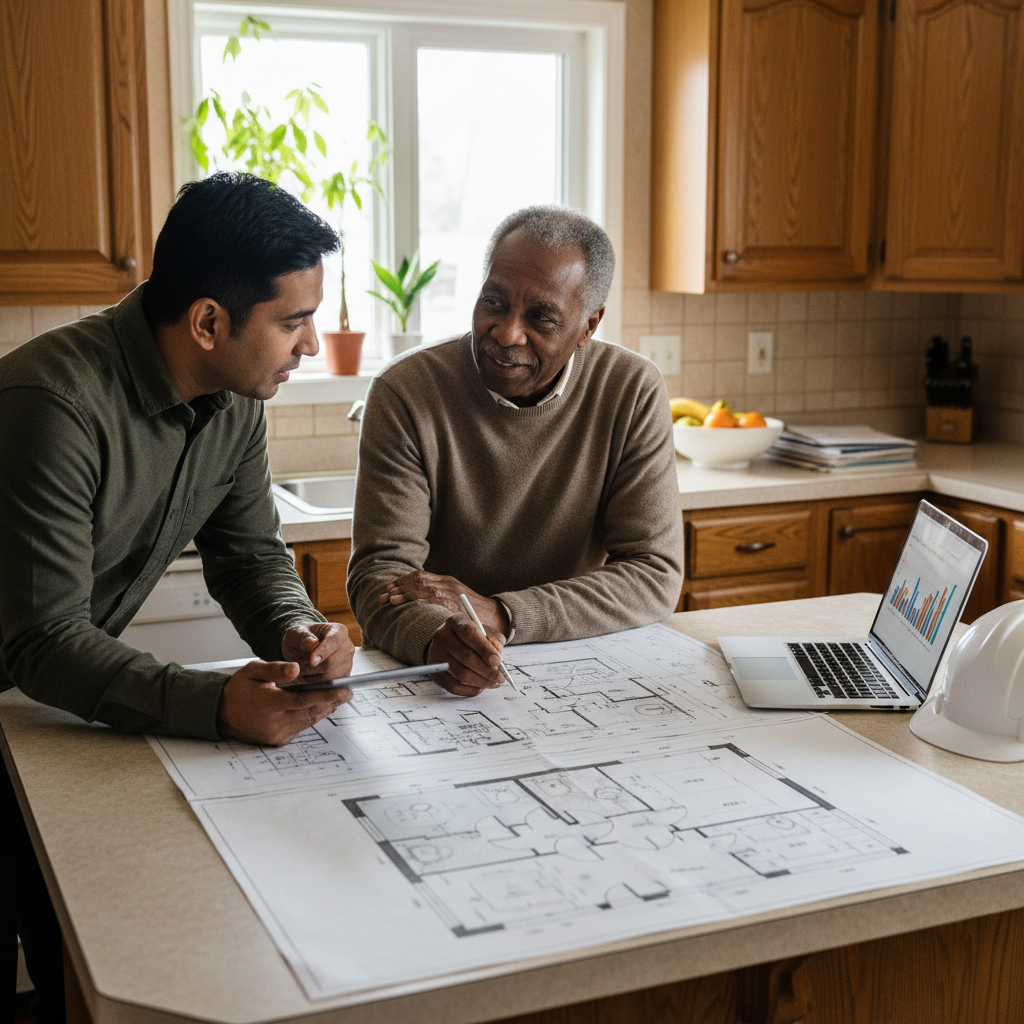
Approach 1: Lump Sum for Immediate Needs
If you know exactly what modifications you need now — for example, a stairlift, bathroom renovation, and exterior ramp — take a lump sum sufficient to cover those projects plus a 10–15% contingency for cost overruns.
Approach 2: Line of Credit for Phased Renovations
If your needs are evolving — perhaps a stairlift now but a bathroom renovation in two years and possibly an elevator in five years — the reverse mortgage line of credit is ideal. You draw funds only as needed, and interest accrues only on the amount drawn. This approach minimizes borrowing costs while ensuring funds are available when you need them.
| Funding Approach | Best For | Interest Advantage |
|---|---|---|
| Lump sum | Known, immediate projects with defined scope | None — interest starts on full amount immediately |
| Line of credit | Phased renovations over several years | Interest only on drawn amounts; undrawn funds cost nothing |
| Combination | Some immediate needs + future flexibility | Balances immediate access with cost efficiency |
All four Canadian reverse mortgage lenders — HomeEquity Bank (CHIP), Equitable Bank, Bloom Financial, and Home Trust — support home renovation as a use of proceeds. There are no restrictions on how you spend the funds, and no lender approval is required for specific renovation projects after closing.
Government Grants and Tax Credits: Stack Them With Your Reverse Mortgage
A reverse mortgage is not the only source of funding for accessibility modifications. Several government programs can reduce your out-of-pocket costs, and they can be used alongside reverse mortgage proceeds:
CMHC Residential Rehabilitation Assistance Program (RRAP) for Persons With Disabilities
This program provides forgivable loans (effectively grants) of up to $16,000 for accessibility modifications to your home. Eligibility is based on household income and the nature of the disability. If you qualify, this can offset a significant portion of your renovation costs.
Canada Revenue Agency: Home Accessibility Tax Credit (HATC)
The HATC provides a 15% non-refundable federal tax credit on up to $20,000 in eligible home accessibility expenses per year. This means a potential tax savings of up to $3,000 annually. Eligible expenses include:
| Expense Category | Examples | HATC Eligible? |
|---|---|---|
| Mobility modifications | Ramps, stairlifts, elevators, grab bars, wider doorways | ✓ Yes |
| Bathroom accessibility | Walk-in tubs, roll-in showers, raised toilets | ✓ Yes |
| Flooring | Non-slip surfaces in key areas | ✓ Yes |
| Lighting | Motion-sensor lights, pathway illumination | ✓ Yes |
| General renovations | Kitchen update, cosmetic improvements | ✗ No (must be accessibility-related) |
| Routine maintenance | Cleaning, lawn care, snow removal | ✗ No |
According to the CRA, you or a qualifying individual (a senior or a person eligible for the disability tax credit) must be the one claiming the HATC. The modification must be of an enduring nature and be integral to the dwelling. Temporary or portable items (such as a freestanding grab bar) generally do not qualify.
Ontario Healthy Homes Renovation Tax Credit (Historical)
Ontario previously offered a provincial tax credit for senior home renovations. While this specific credit is not currently active in 2026, Ontario periodically introduces similar programs. Check with your tax professional or visit the Ontario Ministry of Finance website for current offerings.
Medical Expense Tax Credit
Certain accessibility modifications prescribed by a medical practitioner may qualify for the medical expense tax credit. This includes modifications for a person with a severe and prolonged mobility impairment. The threshold for claiming medical expenses is 3% of net income or $2,759 (2025 figure, indexed annually), whichever is less. Amounts above this threshold generate a 15% federal tax credit.
Rick Sekhon advises clients to coordinate their reverse mortgage funding with available tax credits: "If you are spending $40,000 on accessibility renovations, you may recover $3,000 or more through the HATC alone. That effectively reduces your reverse mortgage borrowing cost. I always recommend clients speak with their accountant before finalizing their renovation budget."
Worked Example: Phased Accessibility Renovations

Consider George and Linda, both age 74, who own a two-storey home in Kitchener appraised at $680,000. George has moderate arthritis and uses a cane. Linda has early-stage mobility challenges following a hip replacement. Their home — purchased in 1989 — has never been modified for accessibility.
Their occupational therapist recommends the following modifications:
Phase 1 (Immediate):
- Stairlift for straight staircase: $4,800
- Grab bars throughout (bathroom, hallways, stairs): $2,200
- Non-slip flooring in bathroom and kitchen: $3,500
- Lever door handles throughout: $800
- Phase 1 total: $11,300
Phase 2 (Within 1–2 years):
- Full accessible bathroom renovation (main floor): $28,000
- Wider doorways (3 doorways): $5,400
- Improved lighting with motion sensors: $2,800
- Phase 2 total: $36,200
Phase 3 (If needed in 3–5 years):
- Main-floor bedroom conversion: $12,000
- Exterior wheelchair ramp: $5,500
- Walk-in tub (upstairs bathroom): $8,000
- Phase 3 total: $25,500
Total potential renovation cost: $72,500 (plus contingency)
George and Linda apply for a reverse mortgage:
| Detail | Amount |
|---|---|
| Home appraised value | $680,000 |
| Maximum reverse mortgage (approx. 45% at age 74) | $306,000 |
| Existing debts on property | $0 |
| Closing costs | $3,200 |
| Net proceeds available | $302,800 |
They structure the reverse mortgage as a combination:
- $15,000 lump sum — covers Phase 1 renovations immediately plus a small buffer
- $287,800 line of credit — available for Phase 2, Phase 3, and other future needs (healthcare, daily expenses, emergency fund)
In Year 1, only $15,000 accrues interest. When they draw $36,200 for Phase 2 in Year 2, interest accrues on $51,200. If Phase 3 is never needed (perhaps their health stabilizes), that $25,500 is never drawn and never costs them a cent in interest.
The HATC provides approximately $3,000 in tax savings in Year 1 (15% of $20,000 cap) and additional savings in Year 2 when Phase 2 is completed. Over the full renovation, George and Linda may recover $5,000–$6,000 in tax credits.
Their total accessibility investment of $47,500 (Phases 1 and 2) costs them nothing out of pocket — no monthly payments, no impact on their CPP, OAS, or GIS, and no reduction in their monthly cash flow. The interest accrues against their home equity and is settled when the home is eventually sold.
For a comprehensive checklist of accessibility modifications, see our renovations accessibility checklist. For broader renovation planning, visit our home renovations guide.
The Economics of Staying Home vs. Moving to Assisted Living
The financial case for accessibility modifications becomes even more compelling when compared to the alternative — moving to assisted living or a retirement residence.
| Option | Monthly Cost (Ontario, 2026) | Annual Cost |
|---|---|---|
| Retirement residence (private room) | $3,500–$6,500 | $42,000–$78,000 |
| Assisted living facility | $4,500–$8,000 | $54,000–$96,000 |
| Long-term care (private/semi-private) | $2,200–$2,800 (co-pay, subsidized beds) | $26,400–$33,600 |
| Staying home with accessibility modifications | $0 (mortgage-free) + property costs | Property taxes + insurance + utilities |
According to the Ontario Long-Term Care Association, the average wait time for a long-term care bed in Ontario is approximately 150 days, with some regions exceeding two years. Retirement residences have no waitlist but cost $42,000 to $96,000 annually.
A $75,000 accessibility renovation funded by a reverse mortgage — with zero monthly payments — is equivalent to approximately one to two years of retirement residence fees. If the modifications allow you to remain in your home for 5, 10, or 15 additional years, the financial savings are enormous. And beyond the money, you remain in your own home, your own neighbourhood, and your own community.
For a complete guide to aging in place in Ontario, including both financial and lifestyle considerations, see our dedicated resource.
Choosing Contractors for Accessibility Work
Not all contractors are experienced in accessibility renovations. The modifications must meet specific standards to be effective and safe:
- Look for Certified Aging-in-Place Specialists (CAPS): This designation, offered through the National Association of Home Builders, indicates training in accessible design and construction
- Request references from similar projects: A contractor who has installed 50 stairlifts will deliver a better result than one doing their first
- Verify licensing and insurance: Ontario requires contractors to carry liability insurance and, for certain work, WSIB coverage
- Get multiple quotes: Accessibility renovation costs vary significantly between contractors. Three quotes is standard practice
- Coordinate with your occupational therapist: If you have an OT assessment, share it with your contractor so the modifications match your specific mobility needs
Rick Sekhon notes that some clients use a portion of their reverse mortgage line of credit to hire a project manager or aging-in-place consultant ($2,000–$5,000) who oversees the entire renovation process. "For couples in their 70s and 80s, managing contractors and timelines is stressful. A project manager pays for themselves in avoided mistakes and scheduling efficiency."
The Role of FSRAO in Protecting Borrowers
The Financial Services Regulatory Authority of Ontario (FSRAO) oversees mortgage brokers and ensures that reverse mortgage transactions meet provincial consumer protection standards. For accessibility-focused borrowers, this means:
- Your broker must assess whether the reverse mortgage is suitable for your circumstances
- You must receive full disclosure of all costs, rates, and terms before committing
- You must obtain independent legal advice before closing
- You cannot be pressured into borrowing more than you need
If you are approached by a contractor who "partners" with a specific lender and pushes you toward a reverse mortgage to fund their renovation quote, proceed with caution. Always work with an independent mortgage broker — like Rick Sekhon — who represents your interests, not the contractor's.
Combining With Other Financial Strategies
A reverse mortgage for accessibility can be part of a broader retirement financial plan:
- Delay CPP/OAS: If you are between 60 and 70, using reverse mortgage funds now allows you to delay government pension benefits, increasing your lifetime CPP/OAS income. See our guide on retirement cash flow planning
- Preserve RRSPs/RRIFs: Instead of withdrawing registered funds (triggering tax) to pay for renovations, use tax-free reverse mortgage proceeds and let your registered investments continue to grow tax-deferred
- Fund home care alongside modifications: Accessibility renovations and private home care are complementary. A reverse mortgage line of credit can fund both — ramp installation this year, weekly home care help next year. See our guide on private home care costs
- Living legacy planning: If passing the home to your children is important, plan your accessibility spending carefully and communicate your reverse mortgage use with family. Our living legacy guide provides a framework for these conversations
Frequently Asked Questions
Will the reverse mortgage lender inspect the renovations after they are completed? No. Once the reverse mortgage funds are disbursed, the lender does not inspect or approve specific renovation projects. You are free to use the funds as you see fit. The lender's only ongoing requirement is that you maintain the property in reasonable condition — which accessibility modifications inherently support.
Can I claim the Home Accessibility Tax Credit on renovations funded by a reverse mortgage? Yes. The source of funding does not affect HATC eligibility. Whether you pay for modifications with savings, a reverse mortgage, a HELOC, or any other source, the tax credit applies to eligible expenses. The credit is based on the amount spent, not the source of funds.
What if I need more modifications later than my reverse mortgage covers? If you set up a reverse mortgage line of credit, you can draw additional funds up to your approved limit at any time. If you have already drawn the full amount, you may be able to refinance the reverse mortgage for a higher amount (particularly if your home has appreciated or you have aged, both of which increase the maximum borrowing percentage). Speak with your broker about future flexibility when structuring the initial arrangement.
Are stairlifts and home elevators covered by OHIP or Ontario's Assistive Devices Program? The Ontario Assistive Devices Program (ADP) provides funding for certain mobility aids, but coverage for stairlifts and home elevators is limited. The ADP covers up to 75% of the cost of certain devices (such as wheelchair lifts) to a maximum of approximately $11,000 for residential lifts, but eligibility criteria are strict and waitlists can be long. A reverse mortgage provides immediate, guaranteed access to funds without waitlists or eligibility restrictions.
Should I renovate now or wait until my mobility worsens? Renovating proactively is almost always better. First, you can plan carefully and get competitive quotes rather than scrambling in a crisis. Second, accessibility modifications prevent falls and injuries — waiting until after a fall means the damage is already done. Third, if you use a reverse mortgage line of credit, the funds cost nothing until drawn, so setting up the facility now and drawing later gives you the best of both worlds.
How does FSRAO ensure I am not being overcharged for a reverse mortgage used for renovations? FSRAO does not regulate renovation costs, but it does regulate the mortgage transaction itself. Your broker must disclose all reverse mortgage fees, rates, and terms transparently. If you feel the reverse mortgage costs are excessive or that the broker has not provided adequate disclosure, FSRAO's complaint process is available. For the renovation itself, standard consumer protection laws apply — always get multiple quotes and a written contract.
A stairlift costs $5,000. A fall costs a hip, six months of recovery, and potentially your independence. The financial logic of using home equity to fund accessibility modifications is straightforward — and a reverse mortgage makes it possible without reducing your monthly income by a single dollar. The funds are there, in the walls of the home you have lived in for decades. Using them to stay safely in that home is one of the most practical applications of a reverse mortgage.
Ready to Learn More?
Get the free Ontario Reverse Mortgage Guide and find out exactly how much you could unlock from your home.
Get My Free Guide →Related Articles
Aging in Place with a Reverse Mortgage: Home Modification Guide
How Ontario seniors can fund aging-in-place home modifications with a reverse mortgage — costs, top modifications, grants, and a complete planning guide.
Read →Reverse Mortgage Renovation Checklist: Aging in Place in Ontario (2026)
A complete checklist of aging-in-place renovations Ontario seniors fund with a reverse mortgage — with costs, contractor guidance, and grant stacking tips.
Read →Reverse Mortgage for Workplace Injury Recovery: Supporting Adult Child's Career Transition
Help your adult child rebuild their career after workplace injury. Learn how reverse mortgages fund recovery, retraining, and financial stability during career transition.
Read →