
Reverse Mortgage + Ontario AoO Tax Credit: Maximum Accessibility Benefit Strategy
Combine your reverse mortgage with Ontario's Accessibility for Ontarians (AoO) tax credit. Learn how to fund home modifications and claim maximum tax relief.
Are you planning to age in place but worried about the cost of accessible home modifications? Ontario offers a powerful but underutilized tax benefit—the Accessibility for Ontarians (AoO) tax credit—that can offset up to 30% of accessibility expenses. When combined with a reverse mortgage, this strategy can dramatically reduce the true cost of creating an accessible, aging-friendly home while maximizing tax savings.
This article is for educational purposes only and does not constitute financial advice.

Understanding the Ontario AoO Tax Credit
The Accessibility for Ontarians tax credit is a non-refundable Ontario income tax credit that helps you recover a portion of accessibility-related home modification expenses. This is separate from federal programs and applies specifically to Ontario residents.
Who Qualifies?
You are eligible if:
- You are an Ontario resident (resident for tax purposes on December 31 of the tax year)
- You own the home where you reside
- You have an eligible accessibility expense during the tax year
- You have Ontario income tax payable to claim the credit against
Eligible Accessibility Expenses
| Expense Category | Examples | AoO Credit Eligibility |
|---|---|---|
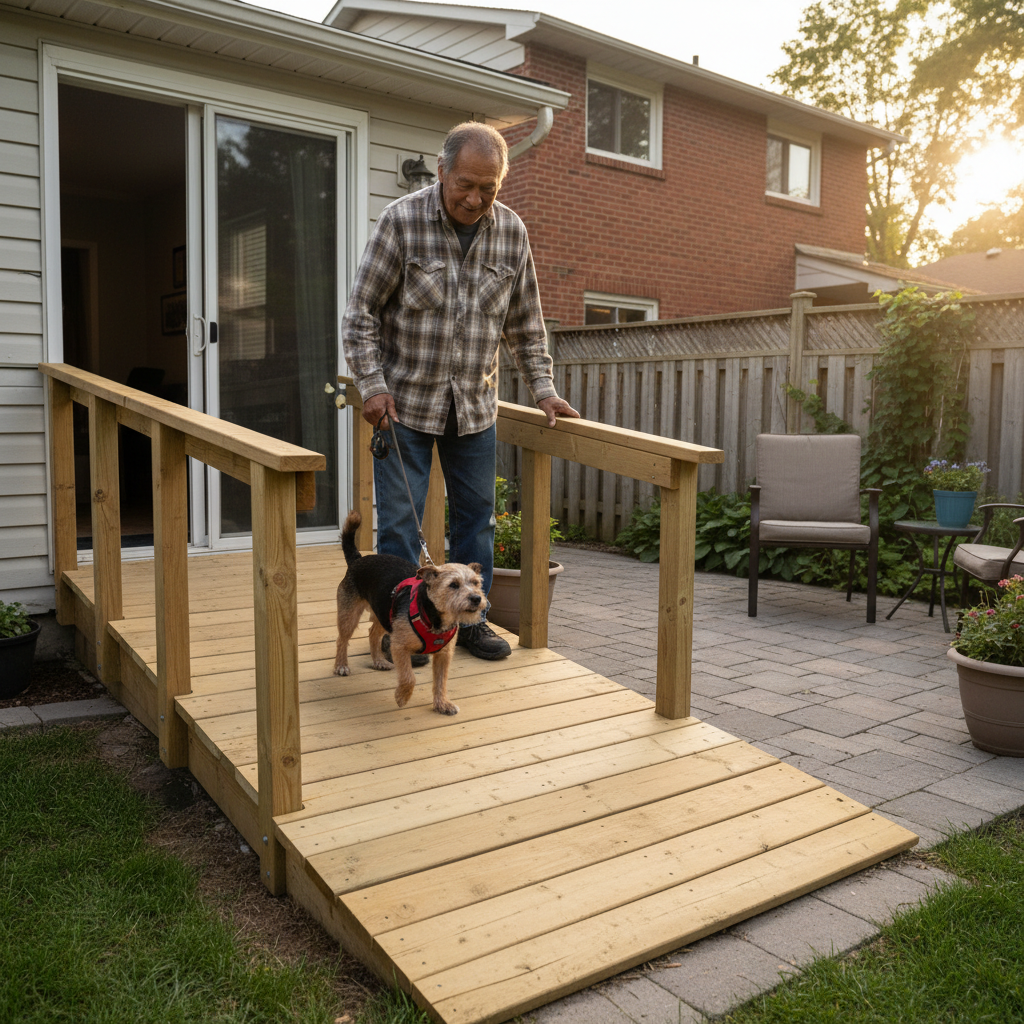
| Structural modifications | Ramps, grab bars, widened doorways, walk-in showers | ✓ Yes |
| Mobility aids | Stairlifts, elevators, lifts, platform lifts | ✓ Yes |
| Bathroom renovations | Accessible toilets, lowered sinks, anti-scald fixtures | ✓ Yes |
| Kitchen modifications | Lowered counters, accessible appliances, pull-out shelving | ✓ Yes |
| Flooring & surfaces | Slip-resistant flooring, level transitions, accessible pathways | ✓ Yes |
| Lighting & controls | Motion-activated lighting, lever-style door handles | ✓ Yes |
| Professional services | Architect/designer fees for accessibility planning | ✓ Yes (partial) |
| General renovations | Kitchen or bathroom upgrades without accessibility feature | ✗ No—must be accessibility-focused |
| Appliances | Standard dishwasher or refrigerator | ✗ No—must have accessibility feature |
| Routine maintenance | Paint, cleaning, repair of existing structures | ✗ No—must be new modification |
Credit Rate: Up to 30%
The AoO credit covers up to 30% of eligible expenses (though the exact rate can vary based on your Ontario tax bracket and other factors). This means:
| Total Accessibility Expenses | Estimated AoO Tax Credit (at 30%) | Net Cost After Tax Benefit |
|---|---|---|
| $10,000 | $3,000 | $7,000 |
| $25,000 | $7,500 | $17,500 |
| $50,000 | $15,000 | $35,000 |
| $75,000 | $22,500 | $52,500 |
| $100,000 | $30,000 | $70,000 |

How to Combine Reverse Mortgage + AoO Tax Credit
The Strategic Timing Model
The most effective approach uses a three-step timing strategy:
Step 1: Take the Reverse Mortgage (Year 1)
Access your home equity through a reverse mortgage lump sum or line of credit. The funds are tax-free—they do not count as income and do not affect your income tax return.
Step 2: Complete Accessibility Work (Year 1–2)
Use the funds to pay for eligible accessibility modifications. Keep all receipts and invoices organized by expense category.
Step 3: Claim the AoO Credit (Year 2–3 Tax Filing)
File your Ontario tax return and claim the Accessibility for Ontarians tax credit on form ON428. The credit reduces your Ontario income tax payable, creating a refund or reducing tax owed.
Real-World Scenario
Diana is 62 and living in her Toronto home. She's experiencing mobility challenges and wants to age in place but cannot afford the $75,000 cost of a full accessibility renovation (accessible bathroom, ramp, widened hallways, grab bars).
Year 1: Reverse Mortgage
- Diana takes a reverse mortgage for $80,000 (she qualifies for $250,000 based on her $400,000 home equity)
- She uses $75,000 for accessibility work
- Interest: ~$5,600 in Year 1 (at 7% APR)
- Tax impact: $0 (reverse mortgage is tax-free)
Year 2: Accessibility Work Completed
- Diana files her tax return and claims the AoO tax credit
- Eligible accessibility expenses: $75,000
- AoO tax credit (at 30%): $22,500
- Diana's Ontario income tax payable is reduced by $22,500
- Net result: She receives a $22,500 tax benefit, reducing her true cost to $57,500
Long-term cost comparison:
- Without reverse mortgage + AoO credit: $75,000 out of pocket
- With reverse mortgage + AoO credit: $57,500 net cost (after tax benefit) + reverse mortgage interest over 10 years (~$85,000) = $142,500 total cost over 10 years
- However, if Diana were to pay for $75,000 in accessibility work without a reverse mortgage, she might need to downsize (real estate transaction costs 5–6% = $20,000–$24,000) or deplete retirement savings, creating tax consequences on RRIF withdrawals. The reverse mortgage strategy keeps her in her home while building in a tax benefit.
Maximizing Your AoO Tax Credit
1. Hire an Accessibility Professional
Working with an occupational therapist or accessibility consultant ensures that:
- Your modifications qualify for the AoO credit
- You avoid modifications that won't qualify (e.g., cosmetic upgrades)
- You plan strategically to maximize eligible expenses
| Expense | Qualification |
|---|---|
| Therapist assessment | ✓ Yes (up to 50% of professional fee qualifies) |
| Architect design for accessible layout | ✓ Yes (50% of design fee) |
| Contractor installation (labor for grab bars) | ✓ Yes |
| Materials for grab bars, ramps, threshold removal | ✓ Yes |
| Accessible shower enclosure (labor + materials) | ✓ Yes |
2. Sequence Your Expenses Strategically
If you have other income sources or plan to work part-time into your 60s, consider timing major accessibility expenses to maximize your tax bracket positioning:
- High-income year + large accessibility expense = larger AoO credit benefit
- Low-income year + small expense = credit may not fully offset tax payable
Speak with your accountant about sequencing to optimize the credit.
3. Document Everything
The CRA and Ontario tax authorities require:
- Invoices and receipts for all accessibility work
- Quotes showing the accessibility feature (vs. cosmetic cost)
- Professional assessment or recommendation (optional but helpful)
Consult a qualified tax advisor for guidance specific to your situation.
Frequently Asked Questions
Do I have to claim the AoO credit in the year the work is done?
No. You can carry the credit forward to future tax years if your Ontario tax payable is insufficient in the current year. However, it's better to claim it sooner to benefit immediately. Your accountant can advise on the optimal timing for your situation.
Can I claim the AoO credit and also apply for federal Disability Tax Credit (DTC) retrofits?
Yes—these are separate programs. Federal programs (Registered Disability Savings Plan grants, DTC-related home renovations) operate independently from the Ontario AoO credit. Many Ontario seniors with disabilities can claim both.
What if my spouse's income is lower than mine? Should they claim the AoO credit instead?
Not necessarily. The AoO credit is tied to the homeowner and their individual Ontario tax payable. If both spouses own the home, each can claim a proportional share of the eligible expenses (e.g., 50% each). Work with your accountant to optimize which spouse claims based on tax brackets.
Is the reverse mortgage interest tax-deductible?
No. Reverse mortgage interest is not tax-deductible because the loan is for personal use, not investment or business purposes. However, the reverse mortgage itself is tax-free—no income tax on the proceeds.
What if I use the reverse mortgage for non-accessibility expenses too?
The AoO credit applies only to eligible accessibility expenses, not to the reverse mortgage as a whole. If you use $75,000 for accessibility work and $10,000 for general home repairs, you claim the credit only on the $75,000. Keep separate receipts by category.
How do I file the AoO credit on my tax return?
The AoO credit is claimed on Ontario Form ON428 (Accessibility for Ontarians Tax Credit) as part of your Ontario personal income tax return. You can file through:
- NETFILE (electronic filing) via your tax software
- Mail-in return to the Ontario Ministry of Finance
- Through a tax professional
What Happens If You Need Long-Term Care?
If you move to a nursing home or retirement residence:
The reverse mortgage triggers repayment (you typically have up to 12 months to sell the home or refinance). However, if your accessibility modifications increase the home's resale value or make it more attractive to buyers, this works in your favor.
According to real estate professionals in Ontario, homes with full accessibility modifications (accessible bathroom, ramp, grab bars, widened hallways) sell 5–8% faster than comparable non-accessible homes in the 55+ market. The AoO-funded modifications essentially become a selling feature that recoups some of the investment.
The AoO tax credit is already claimed on your tax return—the long-term care move does not affect it.
Quick Reference
| Element | Details |
|---|---|
| Program | Accessibility for Ontarians (AoO) Tax Credit |
| Eligibility | Ontario resident, homeowner, eligible accessibility expense |
| Credit Rate | Up to 30% of eligible expenses |
| Reverse Mortgage Role | Funds the accessibility work tax-free |
| Tax Treatment | AoO credit is non-refundable but reduces Ontario tax payable |
| Combined Benefit | Tax-free funds + tax credit = net cost reduction |
| Filing | Form ON428 with Ontario personal tax return |
Frequently Asked Questions
Can I claim the AoO credit if I'm renting, not owning?
No—you must own the home. However, some provinces offer rental accessibility tax credits. Check with your provincial government.
Are there federal programs that overlap with the AoO credit?
Yes. The federal government offers the Disability Tax Credit (DTC), which can cover home accessibility retrofits. You can potentially claim both, but work with a tax professional to avoid double-claiming the same expense.
What's the maximum amount I can claim?
There is no annual cap on eligible expenses for the AoO credit. You can claim $10,000 or $100,000 in the same year if you have the expenses and Ontario income tax payable to offset.
If I sell my home later, do I have to repay the AoO credit?
No. The AoO credit is a one-time benefit. You do not repay it if you sell the home. However, the accessibility improvements may increase your home's value, reducing any capital gains tax when you sell.
Can I refinance my reverse mortgage to cover accessibility expenses I missed?
Yes. Many reverse mortgage lenders allow you to increase your borrowing at renewal or during the loan term. Discuss this with Rick Sekhon if you want to phase accessibility work over multiple years.
Speak to a licensed mortgage professional. Independent legal advice is required before closing a reverse mortgage in Ontario.
Taking Action
Combining a reverse mortgage with the Ontario AoO tax credit creates a powerful strategy for aging in place affordably. The tax credit reduces your net cost by up to 30%, while the reverse mortgage provides tax-free funds without affecting your government benefits.
Next steps:
- Get a home assessment from an occupational therapist or accessibility consultant
- Gather quotes for eligible modifications and calculate your AoO credit potential
- Contact Rick Sekhon Reverse Mortgages for a reverse mortgage consultation
- Work with your accountant to coordinate tax filing and credit timing
Get your free Ontario Reverse Mortgage Guide →
This content is for illustrative purposes only. Rates may vary. Call Rick Sekhon for the best rates and more information.
Ready to Learn More?
Get the free Ontario Reverse Mortgage Guide and find out exactly how much you could unlock from your home.
Get My Free Guide →Related Articles
Reverse Mortgage for Home Renovations: Aging in Place Guide for Ontario Seniors
Learn how to use a reverse mortgage to fund home renovations and modifications that let you age in place safely and comfortably in your Ontario home. Includes cost examples and step-by-step process.
Read →Aging in Place with a Reverse Mortgage: Home Modification Guide
How Ontario seniors can fund aging-in-place home modifications with a reverse mortgage — costs, top modifications, grants, and a complete planning guide.
Read →Reverse Mortgage Tax Implications in Canada: What Ontario Homeowners Need to Know
Are reverse mortgage proceeds taxable in Canada? How do they affect OAS, GIS, and CPP? A complete guide to the tax implications of reverse mortgages for Ontario seniors.
Read →