
Reverse Mortgage for Multigenerational Homes in Ontario
Can you get a reverse mortgage on a multigenerational home? Legal, financial, and title complexity for shared-ownership properties in Ontario.
"My son and his family live with me in my home. I own the property, but my daughter-in-law manages the household. I'm 68 and need $60,000 for a new roof and updates, but I'm worried a reverse mortgage could complicate their living situation or create legal issues. Can I even get a reverse mortgage?" This question represents a growing reality in Canada: multigenerational homes where seniors, adult children, and grandchildren live under one roof. The financial and legal implications of a reverse mortgage in this context are complex. This guide clarifies what's possible, what risks exist, and how to structure a reverse mortgage responsibly in a multigenerational setting.
This article is for educational purposes only and does not constitute financial advice.
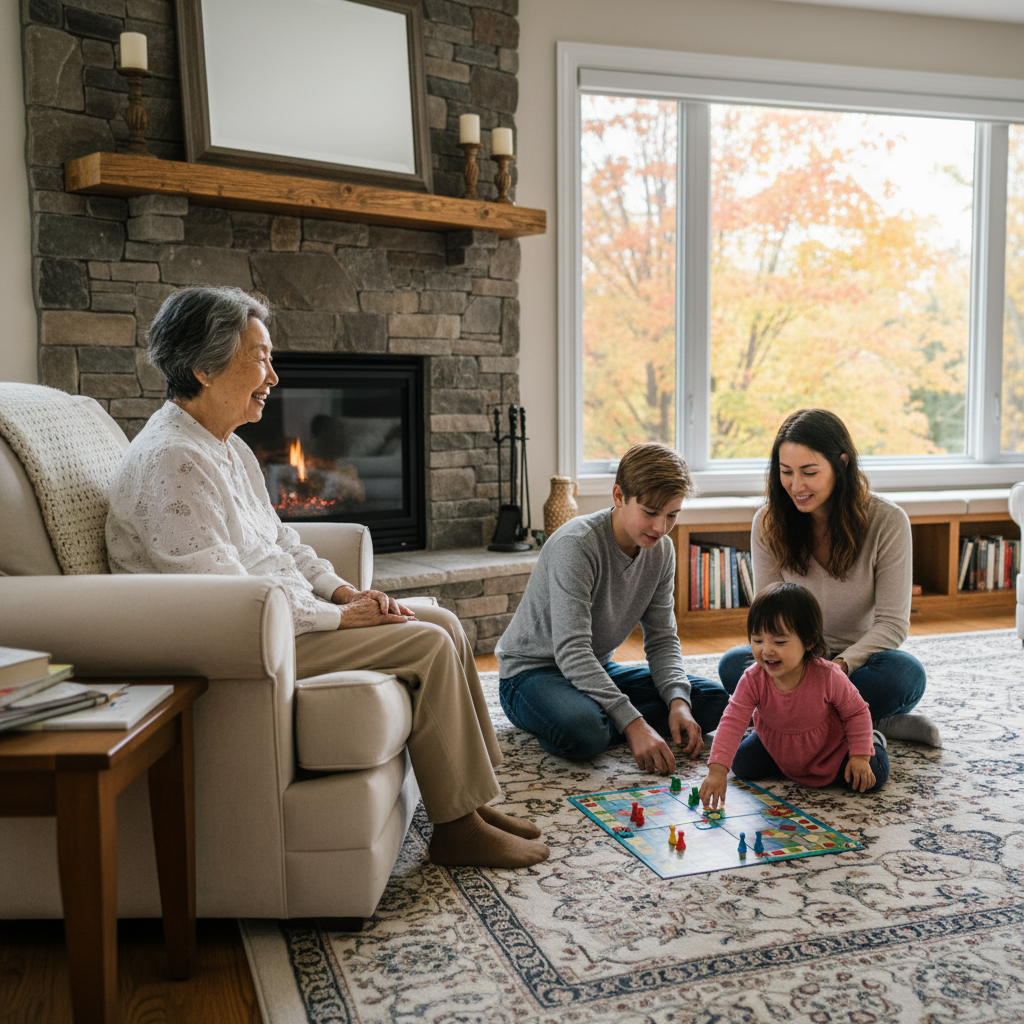
What Is a Multigenerational Home (in Ontario)?
A multigenerational home is a single property occupied by three or more generations (typically grandparent, parent, adult child, grandchildren) or two generations with extended family (parent, adult child + spouse/children).
| Property Type | Typical Structure | Reverse Mortgage Eligible? |
|---|---|---|
| Single-family home, 1 owner, multiple generations | Senior owns; adult children + grandchildren live there | Yes |
| Multi-unit property (duplex/triplex) | Senior owns both units; family lives in one; rents other | Maybe (depends on occupancy structure) |
| Accessory dwelling unit (ADU) | Senior owns main home; adult child lives in separate unit on property | Yes (if ADU is on same parcel) |
| Co-owned property | Senior + adult child both on title | Complex; requires all owners 55+ |
| Trust-owned property | Property held in family trust; senior is trustee or beneficiary | Complicated; requires legal review |
The critical distinction: Does the property have a single registered owner, or are there multiple owners on the title?
Single-Owner Multigenerational Homes (Straightforward)
If you are the sole registered owner of the property, and your adult children and grandchildren live with you as residents (not co-owners), a reverse mortgage is straightforward.
Reverse mortgage lender requirements:
- You must be 55 or older ✓
- You must be the registered owner of the property ✓
- The property must be your principal residence (you live there) ✓
- Title must be clear or mostly clear (no other registered owners' mortgages on the title) ✓
The fact that your son, daughter-in-law, and grandchildren live there is irrelevant to the lender. They are residents, not owners. The lender's security is your ownership and the property's equity.
Process:
- You apply for reverse mortgage in your name only
- Lender appraises property and confirms your ownership
- You receive the loan; your children remain residents
- At your death or when you sell/move, the reverse mortgage is repaid from proceeds
Key point: Your adult children have no legal claim to the home (unless you've added them to the title or left it to them in your will). They are living there by your permission.
Co-Owned Multigenerational Homes (Complex)
If your adult child is also registered on the property title, reverse mortgage complexity increases significantly.
Why title matters:
- Lenders require all registered owners to be 55+ (to approve a reverse mortgage)
- All owners must sign the reverse mortgage documents
- All owners are jointly and severally liable for repayment
- If any owner is under 55, reverse mortgage is not available
Scenario 1: Adult Child is Co-Owner and 55+
If your adult child is 55+ and on the title, they can co-borrow on the reverse mortgage.
Reverse mortgage terms in this case:
| Term | Impact |
|---|---|
| Both borrowers | Both you and adult child are named borrowers |
| Liability | Both are jointly liable; either can be pursued for repayment |
| Death/disability | If one borrower dies, the other remains liable; reverse mortgage continues |
| Sell or move | If either owner wants to sell, the reverse mortgage must be repaid |
| Divorce/separation | If adult child's marriage ends, spouse may claim interest in the property (complex) |
| Inheritance | If you pass away first, your adult child inherits the property AND the reverse mortgage debt |
Example:
- You (72) and your adult son (60) both own the home
- You borrow $75,000 via reverse mortgage
- You both sign; both are borrowers
- At your death, your son inherits the home with a $97,000 reverse mortgage debt (after interest)
- Your son must choose: repay from his own funds, refinance under his own name, or sell the home
Pros of co-ownership: ✓ Both owners benefit from reverse mortgage funds ✓ Clearer ownership/decision-making during life ✓ Simplifies some inheritance questions
Cons of co-ownership: ✗ Adult child becomes liable for mortgage debt ✗ Adult child's ability to borrow/refinance is affected (reverse mortgage shows on their credit/liability) ✗ If adult child passes away first, complicates estate settlement ✗ If adult child's relationship ends, spouse has potential claims on the home
Scenario 2: Adult Child is Under 55 and On Title
This is a problem. Reverse mortgage lenders will not approve if any registered owner is under 55.
Options to resolve:
- Remove adult child from title — Eldest child transfers ownership back to you alone (requires lawyer; title transfer costs ~$1,000–$2,000)
- Wait until child reaches 55 — Apply for reverse mortgage then (may not be practical if you need funds now)
- Gift child the property separately — Change the will to leave the home to the child; don't add them to the title now (reversals take effect after your death)
- Use alternative financing — HELOC or private mortgage (may have income requirements you don't meet)
Most practical solution: Remove the adult child from the title now; add them back in your will for inheritance purposes.
Trust-Owned Multigenerational Homes (Complex)
Some multigenerational properties are held in a family trust (not in personal name) to simplify estate planning or asset protection.
Reverse mortgage challenge with trusts:
- Lenders are cautious about trust-owned properties (adds legal complexity)
- Some lenders will not finance trust-owned properties
- Lenders that do finance trusts require:
- Trust document review by their lawyer (cost: $500–$1,000)
- Confirmation that the trustee is 55+ (or beneficiary is, depending on structure)
- Confirmation that the trust is irrevocable or terms allow borrowing
- Additional closing costs (legal review)
If your property is in a trust:
- Contact Rick Sekhon to find a lender willing to finance trust-owned properties
- Expect additional legal costs ($500–$2,000)
- Expect longer timeline (2–3 extra weeks)
- Confirm with a lawyer whether the reverse mortgage is permitted under your trust terms
Practical Considerations for Multigenerational Reverse Mortgages
1. The Repayment Risk to Family Members Living in the Home
When you take a reverse mortgage on a multigenerational home, you're creating a lien against the home. At your death or if you move to long-term care:
- The reverse mortgage must be repaid
- The home may need to be sold
- Your adult children and grandchildren lose their residence
Example:
- You borrow $80,000 via reverse mortgage
- At age 75, you have a stroke and move to long-term care permanently
- Your adult son (who's lived in the home 15 years) must leave
- The home is sold; reverse mortgage is paid; remaining equity goes to your estate
- Your son now needs to find alternative housing
Mitigation strategies:
- Clearly communicate to family that the home may need to be sold if you require long-term care
- Discuss alternative housing options before borrowing
- Consider leaving explicit instructions in your will to prioritize your adult child's housing needs from remaining estate equity
- Explore long-term care insurance as an alternative (prevents forced home sale)
2. Relationship Changes (Divorce, Separation, Family Conflict)
Multigenerational homes are common because families need to live together for financial reasons, not always by choice. If relationships deteriorate:
Scenario: Adult child's marriage ends
- Adult child is living in "your" home with their spouse
- Divorce is initiated; spouse claims interest in the family home
- Reverse mortgage complicates the property division
- Legal fees mount; family conflict intensifies
Scenario: Family conflict escalates
- Tensions rise between generations
- Adult child wants their own space (or to leave)
- You need the reverse mortgage proceeds for health/care
- Your adult child objects to using home equity; conflict erupts
Mitigation:
- Consider a written family agreement (not legally binding, but clarifies intentions)
- Consult a family lawyer before taking the reverse mortgage (not after)
- Discuss the reverse mortgage with all family members who live in the home
- Be explicit: "This is my home; I own it; you live here by my permission"
3. Long-Term Care and Forced Home Sale
The most practical risk: if you move to long-term care, the reverse mortgage becomes due, and the home must be sold.
This affects:
- Your adult children's housing security
- Your grandchildren's stability (school, friends, community)
- Family finances (may need to use home equity to pay for care)
Example:
- You borrowed $100,000 at age 68
- At age 78, you have cognitive decline and need nursing home care
- Home is now worth $700,000; reverse mortgage balance is $180,000
- Home is sold to pay for nursing home; proceeds: $700,000 – $180,000 (mortgage) – 5% realtor fees = $350,000
- $350,000 goes to your estate; your adult children lose their home
This is often the real cost of a reverse mortgage in a multigenerational context.
4. Insurance and Property Tax Responsibility
Even in a multigenerational home, you as the owner/borrower are fully responsible for:
- Property taxes (must be current; lender requires proof)
- Homeowners insurance (must be in place; lender requires proof)
- Home maintenance and repairs (lender may require you to address serious defects)
Your adult children living in the home are not responsible for these costs (unless you explicitly make them so via a family agreement). This can create tension if:
- You need reverse mortgage proceeds to pay property taxes
- Adult child assumes they can live in the home "forever" without contributing to taxes/insurance
- Home deteriorates and lender requires repairs
Frequently Asked Questions
Can I add my adult child to the title after taking a reverse mortgage?
No. Once a reverse mortgage is registered, you cannot add co-owners without the lender's consent (and likely their refusal). Wait until the reverse mortgage is repaid to add co-owners.
What happens to my reverse mortgage if my adult child inherits the home?
Your child inherits the home with the reverse mortgage debt. They must choose to:
- Repay the reverse mortgage from their own funds (if they have them)
- Refinance it under their own name (if they qualify and are 55+)
- Sell the home and pay off the reverse mortgage from proceeds (retaining any remaining equity)
Can I specify in my will that my adult child can stay in the home and the reverse mortgage should not be forced?
No. A reverse mortgage is repaid when the home is sold or the primary borrower moves permanently. Your will cannot override the reverse mortgage terms. However, you could leave instructions to your executor to use remaining estate equity to help your child; this is not binding but provides guidance.
If my adult child is on the title and I take a reverse mortgage, are they liable for the debt if I pass away?
Yes. If you and your adult child are co-borrowers on a reverse mortgage, both are liable. Your child remains liable after your death. However, the primary liability is the home itself (secured by the reverse mortgage), not a personal debt.
Can I use reverse mortgage proceeds to add a second dwelling unit (ADU) for my adult child?
Yes, if the ADU is on the same parcel and you remain the owner. The reverse mortgage is secured against the entire property (main home + ADU). However, if your adult child wants to own the ADU separately, that's a different legal structure (requires separation of title and likely makes the ADU ineligible for reverse mortgage financing).
Is it common for multigenerational homes to have reverse mortgages?
Growing, but still relatively uncommon. Most reverse mortgages are taken by seniors who own homes outright or nearly outright, without other family members on the title. Multigenerational ownership adds legal complexity that lenders are cautious about.
Consult an estate planning lawyer for advice specific to your family situation.
Speak to a licensed mortgage professional. Independent legal advice is required before closing a reverse mortgage in Ontario.
This content is for illustrative purposes only. Rates may vary. Call Rick Sekhon for the best rates and more information.
Ready to Learn More?
Get the free Ontario Reverse Mortgage Guide and find out exactly how much you could unlock from your home.
Get My Free Guide →Related Articles
Reverse Mortgage Application Process: Step-by-Step Guide for Ontario
Complete step-by-step guide to the reverse mortgage application process in Ontario. Learn the timeline from first call to funding, typically 3-6 weeks.
Read →Gift Home Equity to Family with a Reverse Mortgage in Canada
How Canadian seniors use a reverse mortgage to gift home equity to children and grandchildren as a living legacy — the financial, tax, and family planning details.
Read →Reverse Mortgage Eligibility in Ontario: Complete 2026 Guide
Everything Ontario homeowners need to know about qualifying for a reverse mortgage in 2026. Covers age requirements, home equity, property types, and the application process.
Read →