
Gift Home Equity to Family with a Reverse Mortgage in Canada
How Canadian seniors use a reverse mortgage to gift home equity to children and grandchildren as a living legacy — the financial, tax, and family planning details.
"I have $800,000 sitting in my home that I can't access — and my children are struggling to buy their first home. Why can't I help them now?" This question is at the heart of the living legacy approach to home equity. Rather than waiting until death to pass on the value locked in your home, a reverse mortgage allows you to gift real money to your family while you are alive to see the impact. This guide explains how it works, what the tax and estate implications are, and how families across Canada are making this strategy work.
This article is for educational purposes only and does not constitute financial advice.
The Home Equity Paradox
For most Ontario seniors, the family home is the largest single asset they own — often representing 60%–80% of their total net worth. But it is also the least liquid. You can see the equity on paper; you cannot spend it without either selling the home, taking on conventional debt (which requires income qualification), or accessing a reverse mortgage.
This creates a paradox: your family may have genuine financial needs right now — a down payment, student debt, a medical expense, starting a business — while you sit on hundreds of thousands of dollars you cannot access without disrupting your own life.
According to Statistics Canada, the median home value for Canadians aged 65–74 exceeds $650,000, while the median after-tax income is approximately $38,000 per year. The imbalance between illiquid wealth and liquid income is one of the defining financial characteristics of Canadian seniors.
A reverse mortgage bridges this gap — allowing you to access your equity and direct it where you want it to go, on your timetable, while you are still here.
What "Living Legacy" Means in Practice
The living legacy concept — sometimes called an "early inheritance" — is the practice of transferring wealth to the next generation during your lifetime rather than leaving it all at death. Reverse mortgages make this possible for asset-rich, income-constrained seniors.
| Living Legacy Use Case | Typical Amount | Family Impact |
|---|---|---|
| Down payment gift for adult child's first home | $50,000–$150,000 | Enables entry into the housing market |
| University tuition for grandchildren | $20,000–$80,000 | Reduces student debt burden |
| Business start-up capital for adult child | $30,000–$100,000 | Creates entrepreneurial opportunity |
| Debt relief gift (adult child's credit cards/student loans) | $20,000–$60,000 | Restores financial stability |
| Family vacation or reunion | $10,000–$30,000 | Creates shared experiences |
| Caregiver compensation (family member who helps you) | Varies | Recognises informal care value |
The Tax Advantage: Gifts vs Inheritance
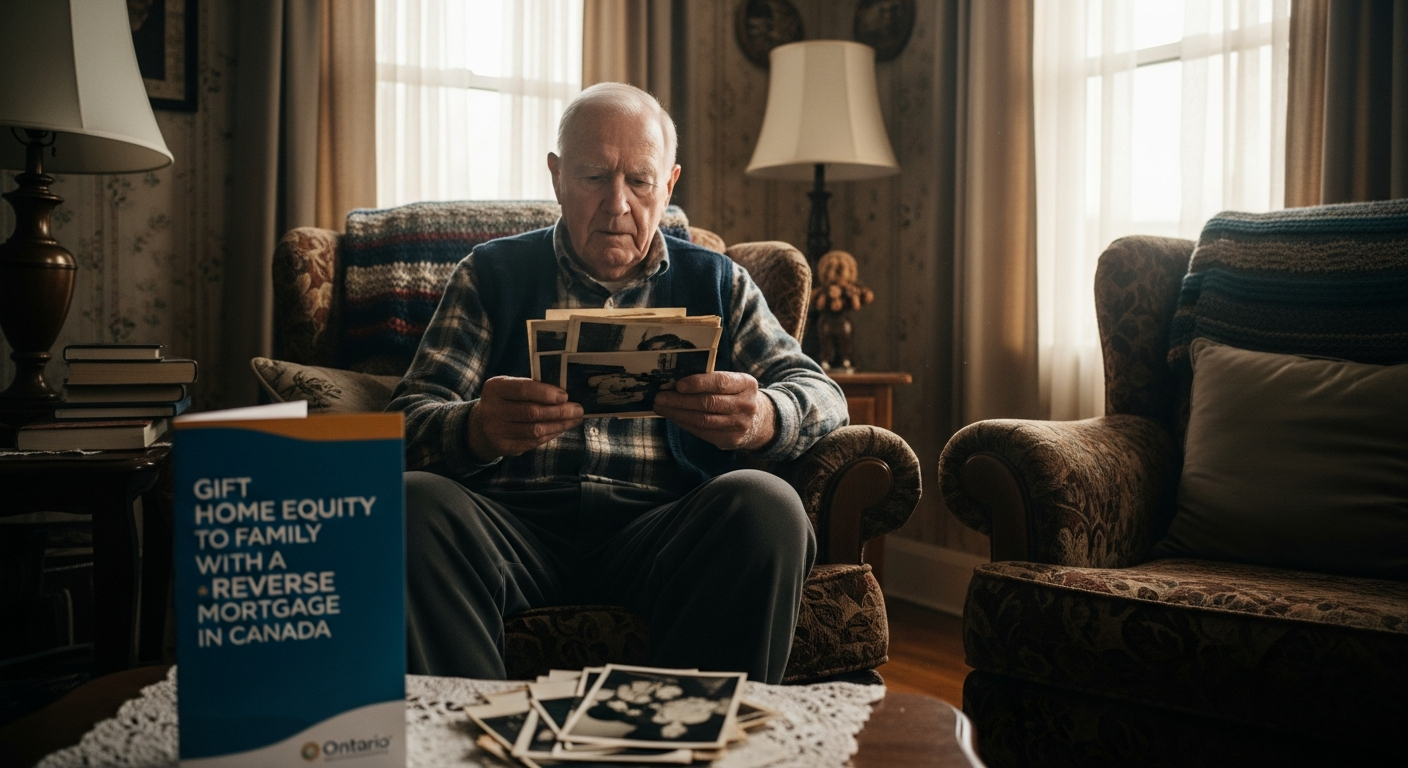
One of the most compelling reasons to gift equity now rather than waiting is the tax treatment.
Gifts during your lifetime (from reverse mortgage proceeds):
- The proceeds are not income to you (as a loan advance)
- You pay no capital gains on a gift from loan proceeds
- The recipient pays no income tax on a monetary gift received from a family member in Canada
- Gifts do not affect the donor's OAS, GIS, or CPP
Inheritance (assets passed at death):
- The estate may owe income tax on deemed dispositions (if investments are sold)
- The principal residence is exempt from capital gains via the Principal Residence Exemption — but this only applies to the home itself, not other assets
- Estate administration and legal fees reduce the net amount heirs receive
- The estate may take 6–18 months to settle, delaying access to funds
According to the CRA (Canada Revenue Agency), there is no inheritance tax in Canada, and monetary gifts between family members are generally not taxable to the recipient. However, the estate of the deceased is subject to deemed dispositions of all capital property at fair market value at the time of death, which can trigger capital gains taxes on non-principal residence assets.
For the reverse mortgage specifically, proceeds given as gifts are simply money — the recipient uses them freely without any tax obligation.
Protecting the Home: How the Numbers Work
The most common objection to the living legacy approach is: "If I give money to my children now, I'll have less equity when I die." This is true — but the question is how much less, and whether that difference matters.
| Scenario | Home Value Today | Reverse Mortgage | Gift to Children | Home Value in 15 Years | Loan Balance in 15 Years | Estate Equity |
|---|---|---|---|---|---|---|
| No reverse mortgage | $800,000 | $0 | $0 | ~$1,441,000 | $0 | $1,441,000 |
| $150,000 reverse mortgage (gift) | $800,000 | $150,000 | $150,000 | ~$1,441,000 | ~$413,000 | ~$1,028,000 |
| $250,000 reverse mortgage (gift) | $800,000 | $250,000 | $250,000 | ~$1,441,000 | ~$689,000 | ~$752,000 |
Assumptions: 4% annual home appreciation, 7% reverse mortgage compounding, 15-year hold.
In all scenarios, meaningful estate equity remains. The question is whether the $150,000 or $250,000 you gifted to your family now — enabling real financial change in their lives — was worth the reduction in eventual estate equity. For many families, the answer is clearly yes.
The No-Negative-Equity Guarantee: Your Family's Safety Net
One concern that often comes up in living legacy discussions is: "What if home values drop significantly?" The No-Negative-Equity Guarantee addresses this directly. Even if a combination of home price decline and compounding interest results in a loan balance that exceeds the home's value at repayment, your estate cannot owe more than the sale proceeds. The lender absorbs the shortfall.
For more detail on how this protects your heirs, see our reverse mortgage inheritance guide →.
How to Structure a Living Legacy Gift
The mechanics of gifting reverse mortgage proceeds to family are straightforward:
- Apply for and receive your reverse mortgage (lump sum or staged draws)
- Transfer funds to your recipient — direct bank transfer or cheque
- Consider documenting the gift intention — a simple gift letter from a lawyer protects against any future claim that it was a loan
- Discuss the estate implications with all beneficiaries — ensure all children understand how the living legacy gift affects eventual estate distribution
- Consider your own security first — only give what you can afford given your own retirement income needs
Practical tip: the staged draw approach Rather than gifting a single large lump sum, some families structure a reverse mortgage as a staged draw — for example, $2,000/month drawn over several years. This provides ongoing support (e.g., helping a child with housing costs) while limiting the compounding effect of borrowing a large sum upfront.
Family Communication: The Most Important Step
The most common source of conflict in living legacy planning is not the financial structure — it is the communication. Specifically, when one adult child receives a significant gift while others do not, or when the gifting is not disclosed to all beneficiaries.
Best practices for family communication:
- Disclose the reverse mortgage to all adult children who are beneficiaries of your estate
- Explain your reasoning for the living legacy approach
- Discuss whether the gift is to be "equalised" against that child's eventual inheritance share
- Involve a lawyer to document the understanding clearly
- Consider an updated will that reflects any changes in estate distribution
Many families use a family meeting — sometimes facilitated by a financial planner or lawyer — to discuss these plans openly. The conversation, while sometimes emotionally complex, prevents the far more damaging conflict that can arise when a reverse mortgage and large gifts are discovered by surprised heirs after the fact.
The Down Payment Gift: A Common Application
The most frequent living legacy use of reverse mortgage proceeds in Canada is funding an adult child's first home purchase. With Ontario home prices at $700,000–$1,200,000 in major markets, a 20% down payment represents $140,000–$240,000 — an amount that is simply not achievable through savings alone for many young Canadians.
For parents with home equity of $600,000 or more, a reverse mortgage to fund a $150,000 down payment gift is financially feasible and potentially life-changing for the recipient. The parent maintains ownership of their own home, accesses equity without income qualification, and gives their child the gift of homeownership.
According to a 2024 CMHC survey, approximately 28% of first-time homebuyers in Canada received a gift from a parent or grandparent to help fund their down payment, with average gift amounts increasing significantly in high-price markets like Toronto and Vancouver. Reverse mortgages are an underutilised but growing mechanism for these intergenerational transfers.
Accessing the Living Legacy Persona's Resources
For families exploring this approach, the Living Legacy section of our site provides additional tools and resources. The Retirement Cash Flow section covers how to structure reverse mortgage income alongside CPP and OAS to maintain your own financial security while giving.
One Drawback to Plan Around
The reverse mortgage balance grows through compounding — and gifts made from those proceeds are gone from the estate permanently. If you gift $200,000 to a child today and the reverse mortgage balance is $400,000 in 15 years, the net equity available to all beneficiaries has decreased by more than the $200,000 gifted, because of the additional compounding. This is the price of accessing equity early. Plan your gift amount with this long-term compounding effect clearly in mind.
FAQ
Is a gift from a reverse mortgage taxable to my child in Canada? No. Monetary gifts between family members are generally not taxable to the recipient in Canada. The recipient does not need to report the gift as income on their tax return. However, if the gifted funds are invested and generate returns, those returns are taxable in the recipient's hands.
Can a reverse mortgage gift reduce the recipient's government benefit eligibility? Receiving a one-time monetary gift does not affect federal government benefit eligibility (EI, CPP, OAS are all contribution or age-based, not means-tested for working-age recipients). However, provinces have different rules for social assistance eligibility — if the recipient is on provincial social assistance, a large gift may affect their benefit temporarily.
How do I ensure the gift is treated fairly across multiple children? The most common approach is to update your will to reflect that the gifted amount is an "advancement" — meaning it is deducted from that child's eventual share of the estate. Alternatively, you can gift equally to all children at the same time, if your reverse mortgage limit supports it. A lawyer and estate planner should be involved in structuring this fairly.
What happens if I die before I have given all the intended gifts? Any unspent reverse mortgage proceeds are part of your estate at death. The reverse mortgage balance is repaid from the estate (typically from the home sale), and the remaining estate — including any unspent funds — is distributed according to your will.
Can I set up a reverse mortgage as a trust for my grandchildren's education? You cannot name a trust as the borrower of a reverse mortgage. However, you can use reverse mortgage proceeds to fund an RESP (Registered Education Savings Plan) for your grandchildren — a tax-efficient approach to funding their education. Annual RESP contribution limits and lifetime limits apply. Consult a financial planner for structuring.
Does a reverse mortgage gift affect my estate's ability to claim the Principal Residence Exemption? The Principal Residence Exemption exempts capital gains on your home from taxation at death. The existence of a reverse mortgage on the property does not affect your ability to claim this exemption — it remains available as long as the property has been your principal residence for the years it was owned.
Speak to a licensed mortgage professional. Independent legal advice is required before closing a reverse mortgage in Ontario.
Get your free Ontario Reverse Mortgage Guide →
This content is for illustrative purposes only. Rates may vary. Call Rick Sekhon for the best rates and more information.
Ready to Learn More?
Get the free Ontario Reverse Mortgage Guide and find out exactly how much you could unlock from your home.
Get My Free Guide →Related Articles
Reverse Mortgage Eligibility in Ontario: Complete 2026 Guide
Everything Ontario homeowners need to know about qualifying for a reverse mortgage in 2026. Covers age requirements, home equity, property types, and the application process.
Read →Reverse Mortgage Tax Implications in Canada: What Ontario Homeowners Need to Know
Are reverse mortgage proceeds taxable in Canada? How do they affect OAS, GIS, and CPP? A complete guide to the tax implications of reverse mortgages for Ontario seniors.
Read →What Happens to a Reverse Mortgage When You Die in Ontario? A Guide for Families
What happens to your home and reverse mortgage when you pass away in Ontario? A clear guide for homeowners and their families on estate settlement, repayment, and protecting your heirs.
Read →