
Reverse Mortgage or Condo: Which Is the Right Move for Ontario Seniors?
Should you downsize to a condo or stay in your home with a reverse mortgage? Complete financial and lifestyle comparison for Ontario seniors.
"Should we sell this house and move to a condo, or stay here and take out a reverse mortgage?" This is the biggest housing decision many Ontario seniors face. Both options promise independence and financial relief. But which one actually delivers?
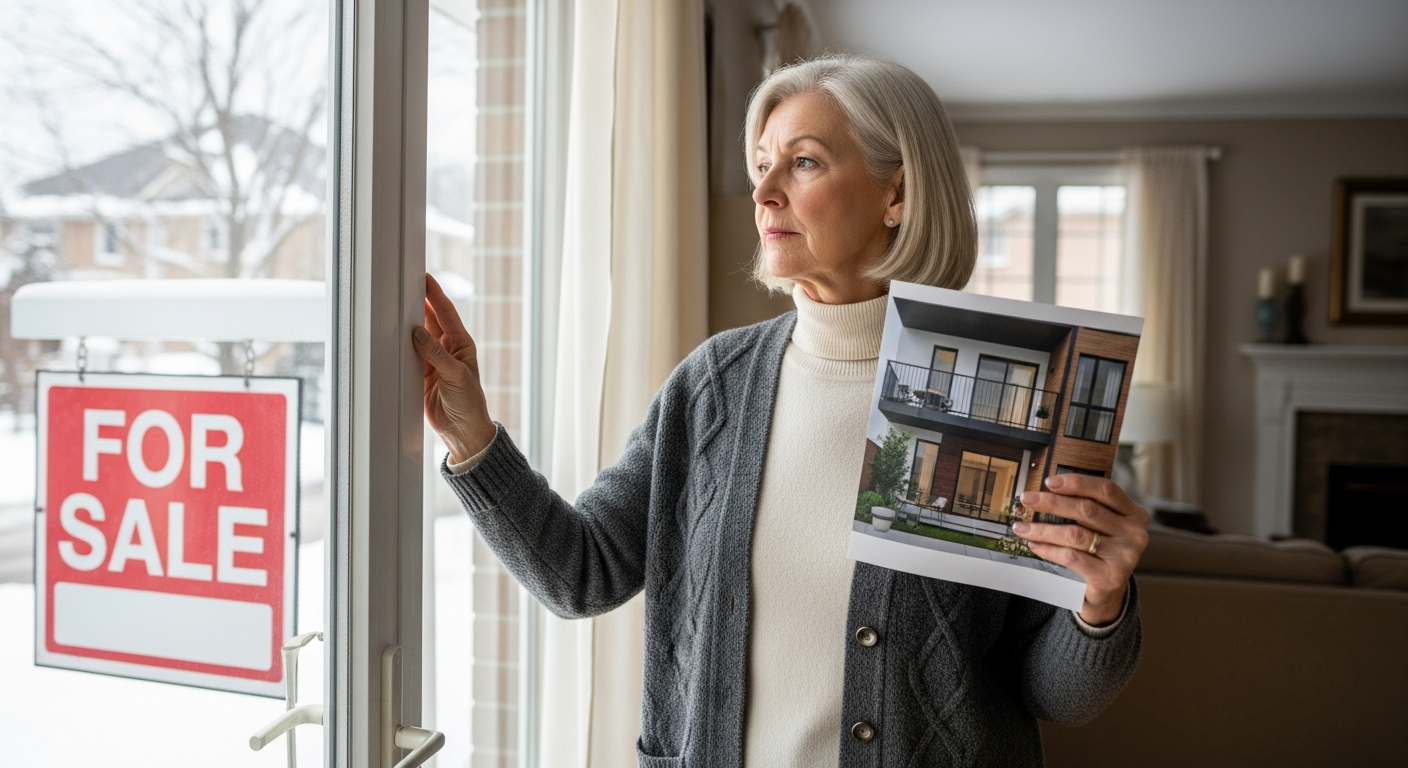
The Real Numbers: Downsizing to a Condo vs. Reverse Mortgage
Let's work through a realistic scenario. You live in a $750,000 home in the GTA, it's fully paid, and you're trying to decide between:
Option A: Sell and Downsize to a Condo
| Cost | Amount |
|---|---|
| Home sale price | $750,000 |
| Real estate commission (4.5%) | -$33,750 |
| Legal/closing costs on sale | -$7,500 |
| New condo purchase price | -$400,000 |
| New condo legal/inspection/title insurance | -$10,000 |
| Moving costs | -$8,000 |
| New furnishings/updates | -$15,000 |
| Total net cash after downsizing | $275,750 |
| Monthly condo fees | $400-600 |
| Annual property tax on condo | $3,200-4,800 |
Option B: Stay Home with Reverse Mortgage
| Cost | Amount |
|---|---|
| Reverse mortgage borrowed | $200,000 |
| Closing costs (2-3%) | -$5,000 |
| Interest over 10 years | -$120,000 (approx) |
| Net funds available | $75,000 (plus home still owned) |
| Annual interest cost (rising as balance grows) | ~$12,000-15,000/year |
| Maintain: property tax | $6,500/year |
| Maintain: insurance | $1,500/year |
| Maintain: repairs | $3,000-5,000/year |
On paper, selling and downsizing puts $275,000 in your bank account immediately. The reverse mortgage puts $75,000 in your bank account and you maintain the $750,000 home.
But money isn't the whole story.
The Hidden Costs and Gains of Downsizing
When you sell your home, you gain cash but lose things that are hard to quantify:
| Loss | Impact |
|---|---|
| Familiar home and community | Emotional displacement, disruption to routines, loss of neighborhood connections |
| Space and privacy | Condos are smaller; shared walls; limited private outdoor space |
| Control | Condo board decides maintenance, renovations, common area changes |
| Hosting family | Can't host grandchildren overnight if you only have 1 bedroom |
| Asset growth | Your $400,000 condo might appreciate 3%/year; your $750,000 home would appreciate $22,500/year |
| Flexibility | If you hate the condo, moving again is expensive and disruptive |
But you also gain:
| Gain | Impact |
|---|---|
| Lower maintenance | No roof worries, no foundation issues, no property upkeep |
| Lower taxes and insurance | Smaller home = smaller bills |
| Liquid cash | $275,000 in the bank is flexibility and security |
| Walkable neighborhoods | Many condos are downtown with walkable services |
| Less house to manage | If mobility becomes an issue, smaller space is easier |
| Resale flexibility | Condos sell faster than large homes |
According to research from the Canadian Retirement Income Security Evaluation (C-RISE), seniors who downsize report lower ongoing stress about maintenance and taxes, but 40% report regret about losing their home within 3-5 years.
The Hidden Costs and Gains of a Reverse Mortgage
Costs of staying home with a reverse mortgage:
| Cost | Impact |
|---|---|
| Interest compounds | You owe $200,000 now, but over 15 years, with interest, it could grow to $350,000+ |
| Maintenance is your responsibility | Big repairs are still on you; your inheritance shrinks when you pay them |
| Property taxes keep rising | Ontario assessments climb; your tax bill could rise 5-10% over 5 years |
| Inheritance reduced | Your children/heirs receive less than they would have |
But you also gain:
| Gain | Impact |
|---|---|
| Stay in your home | Emotional stability, familiar community, independence |
| Keep asset growth | Your home appreciates; you keep the benefit |
| Flexibility | If you don't need the reverse mortgage, you don't have to use it |
| No moving stress | Avoid the disruption and decision-fatigue of selling/moving |
| Hosting family | Still have room for grandchildren, adult children, guests |
| Hedge against inflation | Your home is an inflation hedge; the reverse mortgage is not |
Side-by-Side Comparison
| Factor | Condo | Reverse Mortgage |
|---|---|---|
| Immediate cash | $275,000 | $75,000 (but home valued at $750,000) |
| Monthly costs | Condo fees + tax + insurance ($700-900/mo) | RM interest + tax + insurance ($1,000-1,500/mo) |
| Home maintenance | Minimal | Your responsibility |
| Control over space | Limited (condo board rules) | Full control; your home |
| Hosting family | Limited by size | Full capacity |
| Resale flexibility | Very flexible | Inflexible (must repay RM first) |
| Asset inheritance | $400,000 home + $275,000 cash = $675,000 | $750,000 home - $300,000 RM debt = $450,000 |
| Emotional impact | Possible regret; loss of home | Emotional security; staying put |
| Long-term cost | Rising condo fees + taxes | Rising interest + taxes, but home appreciates |
| Health/mobility changes | Easier to manage small space | More accessible if you've renovated for aging |
| Forced move risk | Low; you control it | Higher; if you need LTC, less flexibility |

The Real Decision: What Are You Actually Optimizing For?
Stop comparing finances for a moment. What do you actually want?
Choose Downsizing to a Condo If:
✓ You're tired of maintaining a large home ✓ You want to simplify your life and reduce bills ✓ You're happy to trade emotional attachment for financial simplicity ✓ You don't care about hosting family or maintaining a large space ✓ You want to live in a walkable urban area near services ✓ You're concerned about maintaining the home as you age ✓ You want maximum liquid cash for flexibility ✓ You're willing to accept 5-10% regret risk about the decision ✓ You prioritize lower ongoing monthly costs
Choose Reverse Mortgage If:
✓ You love your home and can't imagine leaving ✓ You want to stay in your familiar community ✓ You want to host grandchildren, family visits ✓ You want your home to keep appreciating ✓ You're not concerned about maintenance (or can hire help) ✓ You want to keep maximum flexibility ✓ You prefer having your home as a safety net ✓ Your health is good and you plan to age in place ✓ You're more comfortable with debt than with selling
Real-World Scenarios
Scenario 1: Linda (Age 74, alone, loves her community)
Linda lives in a $650,000 house in her lifelong neighborhood. All her friends live nearby. Her daughter lives 20 minutes away. Linda's house has moderate maintenance needs.
Decision: Reverse mortgage ($180,000) Why: Linda's primary concern was staying in her community and being able to host her grandchildren. Downsizing would have moved her away from friends and made her feel displaced. The RM gave her the flexibility to access capital while maintaining her identity in the neighborhood. She'll likely die in this house, and her daughter will inherit it (minus the RM). That's okay with both of them.
Scenario 2: Robert and Sheila (Age 78 and 76, active, traveling)
Robert and Sheila live in a $800,000 home in a quiet suburb. They're healthy and active, travel 4 months/year, and don't care about having grandchildren stay over. Their kids live in different cities. Maintaining the house feels like a burden.
Decision: Downsize to condo ($450,000) Why: They were traveling 4 months/year anyway, so being in a smaller condo with low maintenance was actually freeing. The $350,000+ in cash they received allowed them to travel more. They bought a small downtown condo walkable to restaurants and services. No regrets; their life actually improved.
Scenario 3: Patricia (Age 81, widowed, health declining)
Patricia's husband passed away 2 years ago. She's in her $725,000 home alone. She's starting to need home care (4 hours/day). Her son wants her to move to a care community; she wants to stay home.
Decision: Reverse mortgage ($250,000) Why: Patricia isn't capable of managing a house sale and a move to a new condo right now. Her health is declining. A reverse mortgage gave her immediate funds for in-home care while letting her stay in her home—the place where all her memories are. When she eventually moves to a care facility, her son will sell the home and repay the RM from proceeds. This bought her 2-3 years of independence and dignity at home. Invaluable.
The Financial Truth Over Time
20-year outcome if you downsize:
- Original proceeds: $275,000
- Interest on bank savings: ~$55,000 (at 2% average)
- New condo appreciation: $450,000 → ~$680,000
- Total assets: $680,000 + remaining cash
- Monthly costs: Stable (condo fees locked in, property tax changes minimal)
20-year outcome if you get a reverse mortgage:
- Original home: $750,000 → ~$1,125,000 (assuming 3% appreciation)
- Reverse mortgage debt: $200,000 → ~$600,000 (with compound interest)
- Net estate value: $1,125,000 - $600,000 = $525,000
- Monthly costs: Rising (taxes rise, maintenance rises, RM interest rises)
On paper, downsizing looks better financially. But that's only if:
- Your condo appreciates as projected
- You don't regret leaving your home (psychology affects spending)
- You don't face unexpected major expenses
- You live the full 20 years in the same condo
Real life is messier. Some people who downsize spend their savings on travel because they feel they deserve it. Some get depressed about losing their home and their health declines. Some love the condo and thrive. It varies.
Questions to Ask Before Deciding
Financial questions:
- How much equity do you actually need to access?
- What are your monthly expenses now, and how would they change in a condo vs. staying home?
- Do you have liquid savings to cover emergencies, or would you need to access the RM/cash from downsizing?
- How long do you expect to live? (Your break-even point differs based on longevity)
Emotional/lifestyle questions:
- How important is your current home and community to you?
- Are you still hosting family, or is that era over?
- Do you feel overwhelmed by home maintenance, or do you enjoy it?
- How would you feel moving to a completely new environment?
- Are there specific memory-laden rooms/spaces you couldn't leave?
Health and practical questions:
- Is your current home adaptable if you need mobility aids (wheelchairs, etc.)?
- Is your current neighborhood walkable to services?
- Do you anticipate needing long-term care within 10 years?
- If health declines, could you manage a smaller space, or do you need your current layout?
Quick Reference: Choosing Between Options
| Your Priority | Better Choice |
|---|---|
| Simplicity & low maintenance | Condo |
| Staying in community | Reverse mortgage |
| Liquid cash for travel | Condo |
| Hosting family/grandchildren | Reverse mortgage |
| Peace about home being paid off | Condo |
| Maximum asset growth | Reverse mortgage |
| Predictable monthly costs | Condo |
| Flexibility & control | Reverse mortgage |
| Early mobility concerns | Condo |
| Good health, want to age in place | Reverse mortgage |
Frequently Asked Questions
Can I get a reverse mortgage on a condo I'm downsizing to?
Yes, you can. So you could downsize to a smaller condo, then get a reverse mortgage on that condo to access more cash. Some couples do this: downsize first for the simplicity, then get a RM on the smaller property.
What if I downsize and then regret it?
You can sell the condo and buy another home, but you'll pay another round of real estate commissions (4.5%), legal fees, and moving costs. So you'd need about $40,000-50,000 in liquid funds to switch back. This is doable but expensive. Choose carefully.
If I get a reverse mortgage, can I change my mind and sell later?
Yes. You can repay the reverse mortgage from the sale proceeds at any time with no penalty. So it's not irreversible.
Is there a "right age" to make this decision?
Generally, sooner is better if you're going to downsize, because:
- You're more capable of managing a move when you're 72 vs. 82
- Downsizing moves should happen when you're healthy enough to enjoy the new place
- A reverse mortgage should be accessed while you're still young enough to qualify for better rates
Which option is better for estate planning?
Both work fine if you plan ahead. With a condo, your heirs inherit a smaller asset but with liquid cash. With a RM, they inherit a larger home but minus the debt. Neither is inherently "better"—it depends on your kids' needs and your goals.
The Bottom Line
There's no universal "right answer." The right choice depends on what matters to you.
If you want simplicity, cash, and lower ongoing costs: downsize. If you want to stay home, maintain community, and keep your asset growing: reverse mortgage.
Or do a hybrid: downsize to a smaller home, then get a reverse mortgage on that property.
The key is deciding based on your values and lifestyle, not just the numbers. Money matters, but so does happiness, independence, and peace of mind.
Talk to Rick Sekhon Reverse Mortgages to model the reverse mortgage option. Talk to a real estate agent to model the downsizing option. Then make your choice based on which future makes you happier.
Ready to Learn More?
Get the free Ontario Reverse Mortgage Guide and find out exactly how much you could unlock from your home.
Get My Free Guide →Related Articles
Reverse Mortgage vs Downsizing: Which Is Right for You?
Compare reverse mortgages and downsizing as strategies to access home equity. Explore pros, cons, and scenarios for each option.
Read →Reverse Mortgage on a Condo in Ontario: Complete 2026 Guide
Learn about reverse mortgages on condos in Ontario, including eligibility requirements, special considerations, and fees involved.
Read →Reverse Mortgage on a Townhouse or Semi-Detached in Ontario
Find out if you can get a reverse mortgage on a townhouse or semi-detached home in Ontario, including eligibility rules, appraisal tips, and lender options.
Read →