
Reverse Mortgage for Accessible Vacation Property: Aging at Your Cottage
Keep your cottage or vacation home accessible as you age. Fund accessibility renovations, mobility aids, and safety upgrades with a reverse mortgage.
Your cottage has been the heart of your family for decades—summers, holidays, multi-generational gatherings. The thought of letting it go as you age feels like losing a piece of your identity. But aging at a cottage presents real challenges: long driveways, steep bathrooms, difficult stairs, isolation in winter. Many Ontarians sell their beloved cottages prematurely because the accessibility costs seem prohibitive.
A reverse mortgage can change this. You can stay at your cottage—even make it more accessible—without the financial burden traditional mortgages or personal loans would create. Your vacation home can remain a family gathering place across your lifetime and beyond.
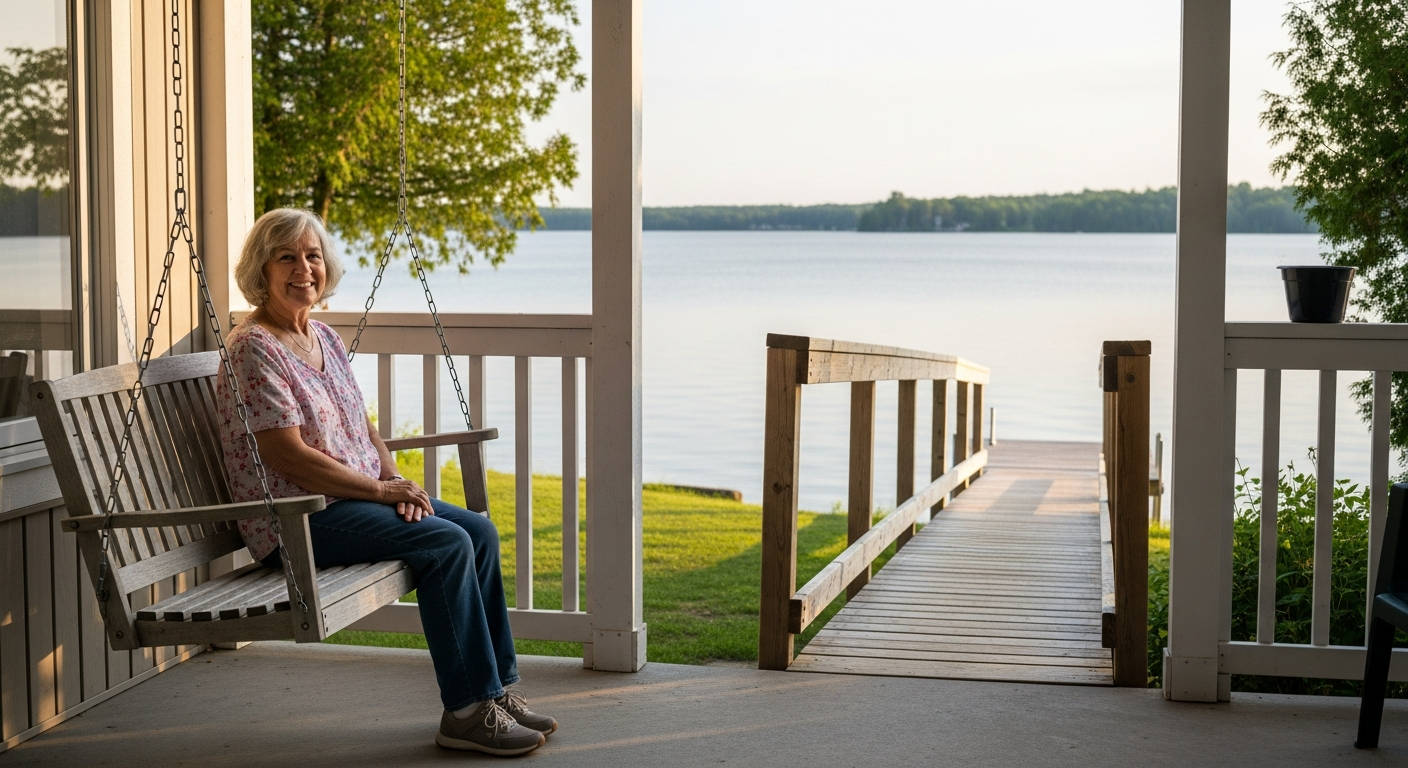
Why Cottages Are Vulnerable to Accessibility Issues
Vacation properties—cottages, lake houses, cabins—are often built:
- On challenging terrain — waterfront, wooded areas, slopes
- In older construction eras — when accessibility wasn't considered
- With summer-use minimalism — small bathrooms, steep stairs, limited living space
- In remote locations — far from support services if you fall or need emergency care
As you age, these features that were charming or irrelevant become serious barriers:
| Cottage Feature | Aging Challenge |
|---|---|
| Deck access over water | Tripping hazard; no handrails; slippery in wet weather |
| Upstairs bedroom only | Can't access at night if mobility declines; unsafe stairs |
| Composting/outhouse toilet | Not accessible if mobility limited; privacy concerns |
| Steep driveway | Can't safely walk to house; snow accumulation in winter |
| Small bathroom | No room for grab bars or mobility equipment; tight showers |
| Open floor with level changes | Trip hazards; stairs between rooms |
| Isolated location | Long response time if medical emergency; can't access services |
Many Ontario homeowners face this choice: invest $30,000–$80,000 in cottage accessibility or sell. Since most cottages are modest properties with equity under $250,000, funding accessibility through traditional mortgages is impractical (can't borrow against a $200,000 cottage to fund $50,000 in renovations—the math doesn't work).
A reverse mortgage on your primary residence can bridge this gap.
Funding Cottage Accessibility from Your Primary Residence
Here's the strategic approach: You likely own a primary residence (worth $400,000–$700,000) and a cottage (worth $150,000–$300,000). You're more likely to qualify for a reverse mortgage on your primary residence.
Using a reverse mortgage on your primary residence, you access substantial equity and allocate some toward cottage accessibility:
Example:
- Primary home value: $550,000
- Primary home reverse mortgage available: $275,000–$300,000 (50-55%)
- Allocation: $250,000 for primary home living expenses; $50,000 for cottage accessibility
- Cottage remains unencumbered; you don't add debt directly to the cottage
This approach: ✓ Keeps your cottage free of additional mortgages ✓ Funds accessibility from your most valuable asset ✓ Doesn't require cottage-specific financing (which is harder to get) ✓ Flexibility to adjust allocations if needed
The reverse mortgage is on your primary residence. The accessibility improvements are on the cottage. Both properties remain yours; nothing changes in ownership.
Cottage Accessibility Modifications by Priority
Not all cottage accessibility costs the same. Prioritize high-impact, moderate-cost improvements:
Priority 1: Critical Safety (Budget: $15,000–$25,000)
- Accessible exterior entrance — ramp or accessible deck; handrails; lighting
- Main-floor bedroom setup — create bedroom on ground floor if possible; if not, stair lift option
- Accessible bathroom — main-floor bathroom with grab bars, accessible shower, raised toilet
- Interior pathways — eliminate throw rugs and trip hazards; add handrails where needed
- Lighting upgrades — bright, motion-sensor lighting in hallways, bathrooms, bedrooms
Impact: These modifications make the cottage livable for aging-in-place. You can comfortably spend summers without major mobility concerns.
Priority 2: Comfort and Convenience (Budget: $8,000–$15,000)
- Kitchen accessibility — lower counters, pullout shelves, accessible appliances
- Secondary bathroom upgrades — if second bathroom exists, make it functional
- Flooring improvements — replace slippery surfaces; add non-slip materials
- Climate control — heating upgrades for early spring/late fall comfort
Impact: Makes the cottage more usable beyond summer; extends seasons when you can stay there.
Priority 3: Long-Term Aging Support (Budget: $10,000–$20,000)
- Mobility equipment installation points — pre-wired for future equipment (ceiling lifts, etc.)
- Accessible outdoor spaces — deck widening, ramp to water if relevant, accessible seating
- Backup power and communications — generator, reliable internet/cell (important for safety)
- Staffing support space — room for caregiver to stay if future care needed
Impact: Future-proofs the cottage for significant aging. If you need in-home care eventually, cottage can accommodate it.
Most Ontario cottages become fully accessible with $35,000–$50,000 in strategic modifications. A reverse mortgage makes this investment financially feasible without selling.
Protecting Multi-Generational Use
But here's the real value: keeping your cottage as a multi-generational gathering place.
If you make the cottage accessible, it remains usable for:
- Your adult children visiting with families
- Grandchildren enjoying summers (even when you need mobility support)
- Extended family gatherings across your lifetime
- Potentially passing the cottage to heirs who continue family traditions
Without accessibility upgrades, aging often forces cottage sales. That ends the family gathering space, disrupts traditions, and eliminates one of the most meaningful assets beyond its financial value.
A reverse mortgage-funded accessibility upgrade preserves all this. Your cottage remains accessible to three generations—you (aging), your adult children, and your grandchildren.
According to Statistics Canada, cottage properties are among the most emotionally valued family assets, yet 35% of Canadian cottages are sold within 5 years of the owner reaching age 75 due to accessibility barriers and maintenance burden. Proactive accessibility planning prevents premature sales.
Addressing the "Second Property" Challenge
Here's a complication: many lenders are cautious about reverse mortgages for homeowners with multiple properties.
Why? Lenders assume second properties consume funds that should secure the primary home. If you're borrowing heavily on your primary residence, second properties increase overall debt exposure.
Solution: Transparent disclosure and strategic structuring.
When you apply for a reverse mortgage (CHIP, Equitable Bank, Bloom Financial):
- Disclose the cottage upfront — don't hide it; it affects your application
- Explain the allocation — make clear that cottage improvement is a subset of overall reverse mortgage use
- Demonstrate cottage equity — if the cottage has substantial value, it strengthens your overall asset position
- Work with your broker — Rick Sekhon Reverse Mortgages can navigate cottage scenarios and find lenders comfortable with second-property accessibility funding
Most lenders will approve reverse mortgages for homeowners with cottages, particularly if:
- Primary residence equity is substantial
- Cottage equity is positive (not mortgaged to the hilt)
- Overall debt levels are reasonable
- Your retirement income is stable
Transparency and professional guidance make this work. Don't apply without disclosing the cottage; that creates legal complications later.
The Inheritance Dimension
Accessibility improvements also enhance the cottage's inheritance value.
When you eventually pass the cottage to your heirs:
- Accessible cottage is more usable by adult children and grandchildren
- Accessibility features make it easier to maintain and enjoy
- If heirs sell, accessibility upgrades add value (many buyers appreciate lower renovation needs)
- Multigenerational accessibility means the cottage serves the family longer
Your reverse mortgage investment in cottage accessibility pays dividends:
- During your life: you stay longer, use the cottage more fully
- To your heirs: improved property, reduced future renovation costs, preserved family gathering space
- To future generations: accessible cottage supports three-generation use
Real-World Scenario: Keeping the Family Cottage
Margaret and Ron's Story (Composite Example)
Margaret and Ron, both 72, own a $550,000 primary home in Toronto and a $220,000 cottage near Muskoka. The cottage has been their family retreat for 35 years. Their three adult children grew up there; grandchildren are now creating memories there.
Ron's mobility has declined; climbing cottage stairs is now risky. Margaret's knees make the steep driveway difficult. They're faced with selling the cottage—a decision that feels like losing their family legacy.
Their solution:
-
Get reverse mortgage on primary home: Access $275,000; allocate $40,000 for cottage accessibility
-
Cottage improvements:
- Main-floor bedroom conversion ($12,000)
- Accessible ground-floor bathroom with grab bars and accessible shower ($8,000)
- Front entrance ramp and deck widening ($8,000)
- Interior handrails and lighting ($6,000)
- Driveway resurfacing with better traction ($6,000)
-
Result: Cottage is now safely accessible. Margaret and Ron can spend summers there comfortably. Adult children and grandchildren continue to gather there across multiple seasons. The cottage remains in the family—not sold prematurely due to aging barriers.
-
Estate outcome: When Margaret and Ron eventually pass, the cottage is both accessible and improved. Heirs can continue the family tradition or sell a more valuable, more usable property.

Frequently Asked Questions
Can I get a reverse mortgage for the cottage itself (not the primary home)?
Possibly, but it's harder. Reverse mortgage lenders prefer primary residences. Some lenders will reverse-mortgage cottages if equity is substantial and your age is 65+, but rates and terms are typically less favorable than for primary homes.
Easier approach: Reverse mortgage the primary home, allocate funds toward cottage accessibility.
What if I only own the cottage and rent my primary residence?
This is trickier. Most reverse mortgage lenders require that the reverse-mortgaged property be your principal residence. If you only own a cottage, you may not qualify for standard reverse mortgages. Consult Rick Sekhon Reverse Mortgages about alternatives.
Can I include the cottage in my reverse mortgage and use funds for primary home expenses?
Yes. A reverse mortgage is on one property, but funds can be used for any purpose (including both properties). You're not required to spend reverse mortgage money only on the mortgaged property.
Will cottage accessibility improvements increase property taxes?
Possibly. Some municipalities assess property tax based on property value. If accessibility upgrades significantly increase the cottage's assessed value, taxes might rise modestly. Check with your municipality about what triggers reassessment.
What if the cottage has an existing mortgage?
The cottage mortgage must be clear before the situation is resolved. Typically, your reverse mortgage is on the primary home (not the cottage), so there's no direct conflict. However, consult a lawyer to ensure no liens or encumbrances create complications.
Your Path Forward
Your cottage is more than a property—it's where your family connects across generations. Age shouldn't force you to sell. A reverse mortgage makes accessibility investments possible, keeping your family gathering place alive and usable for decades to come.
Contact Rick Sekhon Reverse Mortgages to discuss funding cottage accessibility improvements. We'll structure your reverse mortgage to preserve this meaningful family asset while ensuring your safety and comfort as you age.
Ready to Learn More?
Get the free Ontario Reverse Mortgage Guide and find out exactly how much you could unlock from your home.
Get My Free Guide →Related Articles
Aging in Place with a Reverse Mortgage: Home Modification Guide
How Ontario seniors can fund aging-in-place home modifications with a reverse mortgage — costs, top modifications, grants, and a complete planning guide.
Read →Reverse Mortgage on a Cottage or Vacation Property in Ontario (2026)
Can you get a reverse mortgage on a cottage in Ontario? Learn why vacation properties don't qualify, plus strategies to unlock equity using your primary home.
Read →Reverse Mortgage for Workplace Injury Recovery: Supporting Adult Child's Career Transition
Help your adult child rebuild their career after workplace injury. Learn how reverse mortgages fund recovery, retraining, and financial stability during career transition.
Read →