
Reverse Mortgage With Low Home Equity: Can You Qualify in Ontario?
Can you get a reverse mortgage if your home's value is low? Learn how lenders calculate equity, minimum thresholds, and alternatives for Ontario homeowners.
What if your home is worth less than you expected? Many Ontario homeowners worry that if their property value is below the typical range, they won't qualify for a reverse mortgage. The reality is more nuanced — but it helps to understand how lenders assess equity and what your options are if yours is on the lower end.

How Lenders Define "Low" Home Equity
A reverse mortgage requires that your home have sufficient equity to support a loan. What counts as "sufficient" depends on several factors, and the threshold isn't a fixed number across all lenders.
Home equity is the difference between your home's current market value and any outstanding mortgage balance. If your home is worth $300,000 and you owe $50,000 on your mortgage, your equity is $250,000.
Reverse mortgage lenders in Ontario generally look for homes worth at least $250,000 to $300,000, depending on the lender. Some will work with properties as low as $200,000 in certain markets, though this varies significantly by location and property type.
According to CHIP, one of Canada's largest reverse mortgage providers, borrowers typically access 40–55% of their home's value. This means a $300,000 home might yield $120,000 to $165,000 in available funds.
The percentage you can access decreases if your home value is lower, because lenders maintain strict safety margins to protect against future property value declines and ensure they can recover their loan if your home is eventually sold.
Why Lenders Set Minimum Thresholds
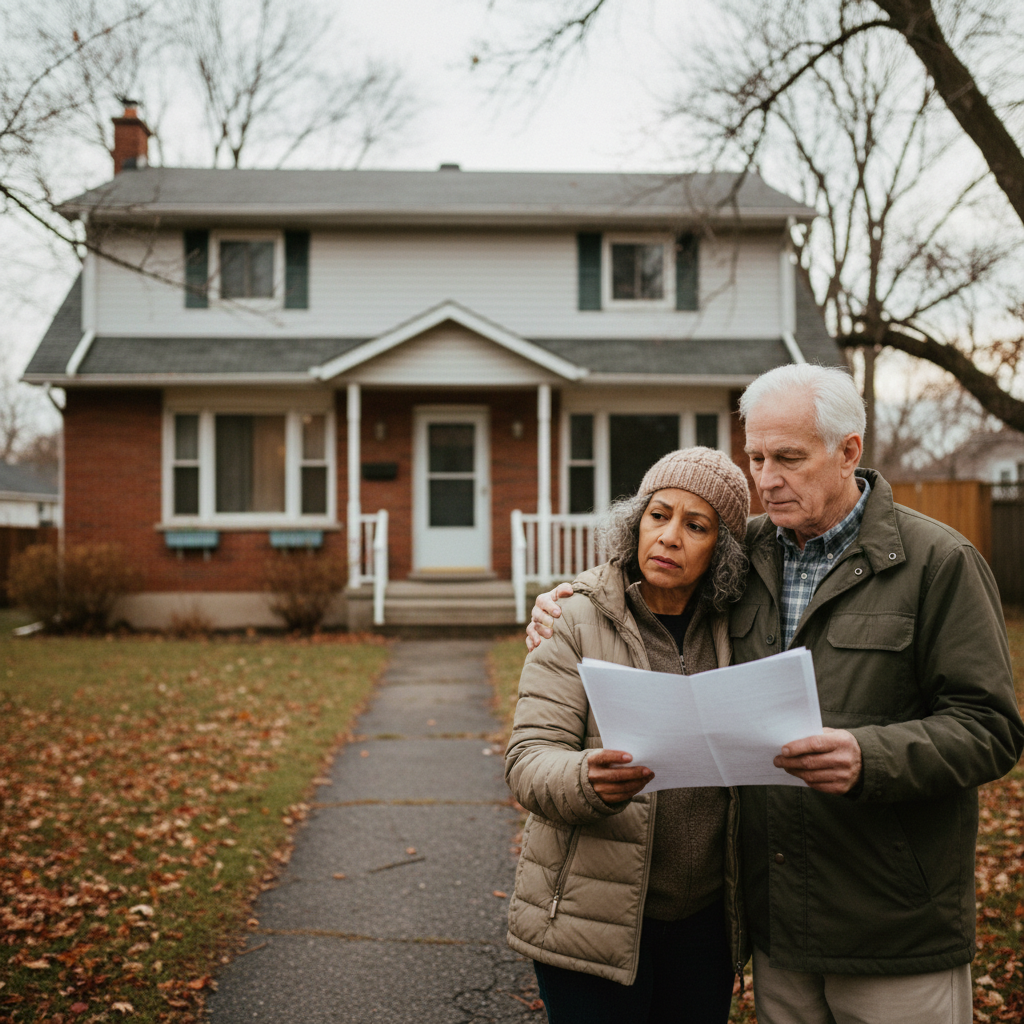
Reverse mortgage lenders follow no negative equity guarantees, meaning they can never recover more than your home's value when the loan is repaid. To protect themselves, they:
- Apply age-based lending ratios. A 65-year-old can access a higher percentage of home value than a 55-year-old, reflecting longer repayment timelines and greater interest accumulation.
- Account for interest growth. Interest compounds over time. A lender must ensure that at age 90 or after 25 years, your loan balance won't exceed your home's value.
- Buffer for market decline. Property values can drop. Lenders assume modest decreases and reserve equity accordingly.
- Cover appraisal and legal costs. These fees ($1,500–$3,000) reduce your net proceeds and must fit within available equity.
Lower-value homes magnify these risks, so lenders either decline applications or offer reduced borrowing amounts — sometimes so small that the costs don't justify proceeding.
| Home Value | Typical Borrowing Percentage (Age 65) | Estimated Max Advance |
|---|---|---|
| $200,000 | 25–35% | $50,000–$70,000 |
| $300,000 | 40–45% | $120,000–$135,000 |
| $400,000 | 45–50% | $180,000–$200,000 |
| $500,000+ | 50–55% | $250,000–$275,000 |
What "Low Equity" Means in Practice
Not every homeowner with a modest-value property falls into the "low equity" category. Context matters.
You might have low equity if:
- Your home is worth $200,000–$250,000 and you're age 55–60
- You have an outstanding traditional mortgage of $100,000 or more against a $300,000 home
- Your property type (mobile home, co-op, leasehold) is restricted and harder to appraise
- You're in a rural or declining-value market in Ontario
You likely have adequate equity if:
- Your home is worth $300,000+ and fully owned (or near-fully owned)
- You're age 65+ with a $250,000+ property
- Your property is in a growing market (GTA, Ottawa, Kingston)
- You own a single-family home, not a specialized property type
When Low Equity Doesn't Disqualify You
Some lenders are more flexible with lower-value homes, especially if you meet other criteria.
Equitable Bank and Bloom Financial have been known to work with lower-value properties in Ontario markets where demand is stable. Home Trust offers competitive terms for homeowners in all equity ranges. The key is shopping around — a decline from one lender doesn't mean all will decline.
If a lender will approve you but your maximum advance seems too small to be worthwhile, ask about:
- Line-of-credit structure. Rather than a lump sum, access funds over time, reducing interest costs.
- Interest-only payments. Some lenders allow you to pay interest monthly, preserving capital and delaying balance growth.
- Refinancing timeline. Apply when your home appreciates or you pay down your existing mortgage.
Realistic Scenarios and Options
Scenario 1: Margaret's $250,000 Home
Margaret, age 68, owns a home worth $250,000 outright in a stable Toronto neighborhood. She qualifies for a reverse mortgage and can access approximately $100,000–$115,000 (40–46% of value). That's modest, but if Margaret needs to fund $15,000 in accessibility renovations and retain $25,000 as an emergency reserve, a reverse mortgage is viable.
Scenario 2: James's $300,000 Home with $80,000 Mortgage
James, 62, owes $80,000 on a $300,000 home. His usable equity is $220,000. After paying off his existing mortgage, he can access roughly $70,000–$80,000 from the reverse mortgage — enough to clear other debts or fund care needs.
Scenario 3: Susan's $200,000 Rural Property
Susan's farmhouse in rural Ontario is worth $200,000 but valued in a declining market. One lender declines, citing property type concerns. She contacts Rick Sekhon Reverse Mortgages for a second opinion and learns that a cooperative lender will appraise her property at $210,000 based on recent comparable sales, unlocking roughly $45,000–$55,000 in accessible funds.
Alternatives When Low Equity Limits Reverse Mortgage Options
If your home equity is genuinely too low for a reverse mortgage to be practical, consider:
| Option | Best For | Key Advantage |
|---|---|---|
| HELOC (Home Equity Line of Credit) | Ages 55–70 with income | No interest until you borrow; flexible access |
| Traditional refinance | Home value $300,000+; able to service payments | Lower interest rates; faster payoff |
| Home sale + downsizing | Willing to move; need capital for retirement | Frees up equity; reduces maintenance burden |
| Government grants | Accessibility/green retrofits; home modifications | Interest-free; don't reduce equity |
| Adult child co-sign | Have supportive adult children | Unlocks higher borrowing (not all lenders allow this) |
According to the Financial Consumer Agency of Canada (FCAC), homeowners should compare all debt options before committing to any strategy. A HELOC might be preferable to a reverse mortgage if you can manage payments and want to preserve equity for heirs.
How to Position Yourself for Approval With Low Equity
If your home value is borderline, take these steps:
- Get an independent appraisal. A professional appraiser might identify comparable sales or property features you weren't aware of, raising value.
- Pay down your existing mortgage. Every dollar paid reduces your loan-to-value ratio and improves your available equity.
- Wait for market appreciation. If your area is growing, waiting 1–2 years might improve your borrowing position.
- Shop multiple lenders. CHIP, Equitable Bank, and Bloom Financial have different criteria and may value your property differently.
- Consider a line-of-credit product. A reverse mortgage line of credit (RMOC) sometimes works with lower values because you access funds only as needed.
- Consult with Rick Sekhon. A licensed reverse mortgage specialist can review your specific property, equity position, and goals to identify the most practical lenders.
FAQ
What's the absolute minimum home value for a reverse mortgage in Ontario?
Most lenders require homes to be worth at least $250,000, though some will work with $200,000–$250,000 properties under specific conditions. There's no strict provincial minimum — it depends on lender policy and your age.
If I have low equity, will all lenders decline me?
No. Different lenders have different thresholds. One may decline while another approves. Always apply to multiple lenders if your first application is declined.
Can I increase my available funds by paying down my existing mortgage first?
Yes. Every dollar paid toward your current mortgage increases your available equity, potentially unlocking more funds from a reverse mortgage.
Does property location affect low equity decisions?
Yes. A $250,000 home in the GTA may qualify easily, while the same value in a rural or declining market might face more scrutiny or lower borrowing ratios.
What if I own a condo or townhouse with low equity?
Condo and townhouse properties can qualify for reverse mortgages, but lenders may apply stricter requirements — sometimes limiting borrowing to 35–40% for condos versus 45–50% for single-family homes.
Is a HELOC better than a reverse mortgage if I have low equity?
A HELOC might be better if you have stable income and want to avoid interest accumulation. A reverse mortgage is better if you're fully retired and need funds without monthly payments.
Take Action
If your home's value is modest but you're considering a reverse mortgage, don't assume you'll be declined. Start by getting a professional appraisal, understanding your exact equity position, and speaking with multiple lenders. Rick Sekhon Reverse Mortgages specializes in finding solutions for Ontario homeowners in non-standard situations — including lower-value properties.
Ready to Learn More?
Get the free Ontario Reverse Mortgage Guide and find out exactly how much you could unlock from your home.
Get My Free Guide →Related Articles
Reverse Mortgage Eligibility in Ontario: Complete 2026 Guide
Everything Ontario homeowners need to know about qualifying for a reverse mortgage in 2026. Covers age requirements, home equity, property types, and the application process.
Read →Reverse Mortgage vs Downsizing: Which Option Is Right for Ontario Seniors?
Compare reverse mortgages to downsizing, HELOCs, and selling—understand the financial and emotional tradeoffs for Ontario homeowners.
Read →How Much Can You Borrow With a Reverse Mortgage in Ontario?
Calculate your reverse mortgage borrowing capacity. Includes LTV limits by lender, age factors, and examples for different Ontario home values.
Read →