
Reverse Mortgage for Insurance Deductible After Home Damage
How a reverse mortgage can cover insurance deductibles after weather damage, theft, or emergency repairs in Ontario. Get the funds you need fast to restore your home.
What happens if a storm damages your roof or a break-in damages your home, but your homeowners insurance deductible is $5,000, $10,000, or even higher? Many Ontario homeowners discover too late that their deductible is far more than they can easily pay — especially in retirement when emergency savings are limited. A reverse mortgage can bridge this gap quickly, letting you repair your home without depleting retirement funds or going into consumer debt.

Why Insurance Deductibles Have Become a Major Problem for Seniors
Homeowners insurance deductibles in Ontario have risen significantly over the past five years. Weather events — ice storms, hail, flooding — have become more frequent, and insurance companies have responded by raising deductibles to manage claims volume.
| Insurance Event | Typical Ontario Deductible (2026) | Your Out-of-Pocket Cost |
|---|---|---|
| Storm or wind damage | $1,000–$2,500 | First $2,500 |
| Hail damage to roof | $2,500–$5,000 | First $5,000 |
| Flood or water damage | $2,500–$5,000 | First $5,000 |
| Theft or break-in | $1,000–$2,000 | First $2,000 |
| Furnace/heating failure | $1,000–$1,500 | First $1,500 |
For a homeowner on a fixed income, even a $2,500 or $5,000 deductible can be a significant hardship — especially when the damage is extensive (roof replacement, major water damage, structural repairs).
The Problem: You're Insured, But Not Protected
Here's the cruel irony: your home is covered by insurance, but you don't have the cash to pay the deductible while the claim is being processed.
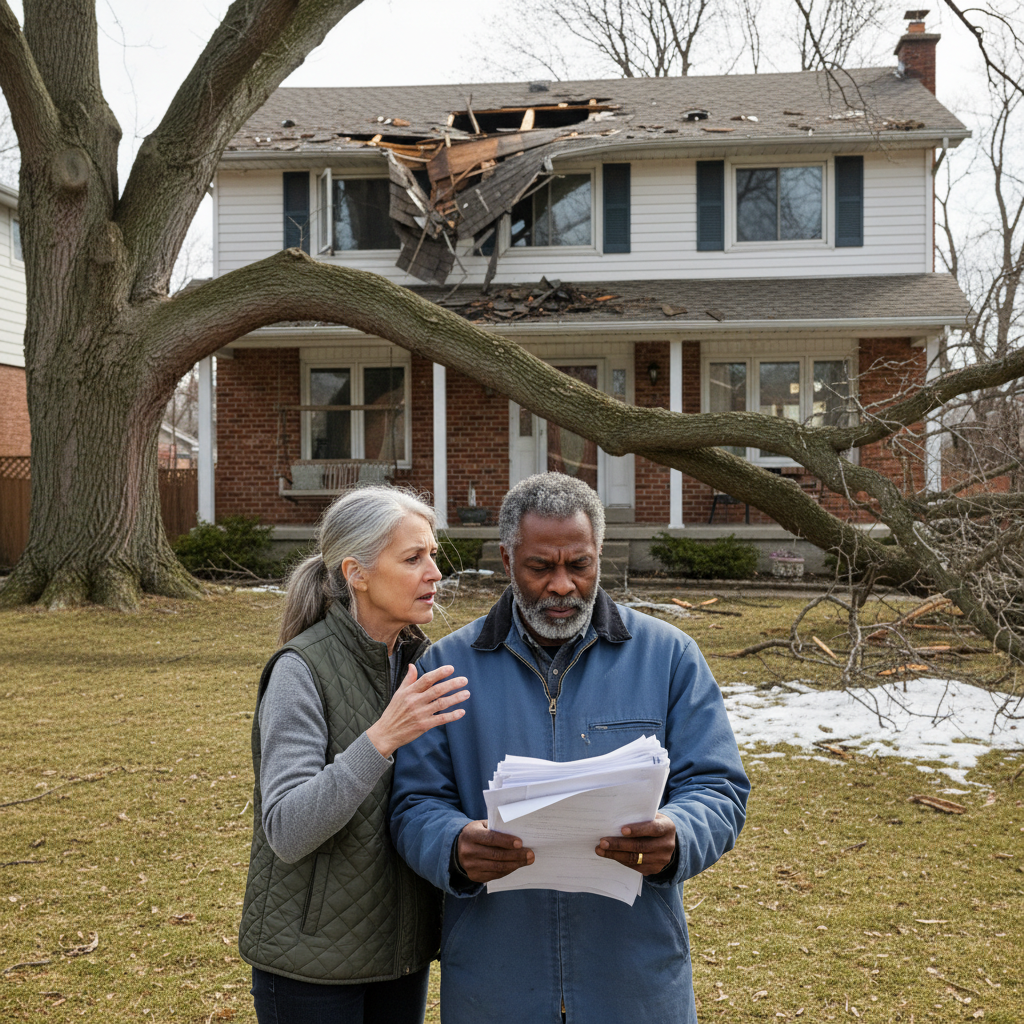
Scenario: A major ice storm damages your roof. Your homeowner's insurance will cover 90% of the $25,000 repair cost — but your deductible is $5,000. You need the roof fixed immediately (you can't wait weeks), but:
- Your savings are limited (you're retired)
- You don't want to liquidate GIC or TFSA holdings (tax issues or loss of growth)
- You don't qualify for a traditional home equity loan (no employment income)
- A personal loan charges 7-10% interest
A reverse mortgage solves this instantly.
How a Reverse Mortgage Covers Insurance Deductibles
A reverse mortgage gives you quick access to your home equity with no monthly payments and no credit score requirements. Unlike a traditional HELOC (Home Equity Line of Credit) — which many Ontario banks will not approve for retirees — a reverse mortgage is designed specifically for homeowners 55 and older.
The process:
- Damage occurs — storm, theft, fire, or other insured event
- File insurance claim — your policy covers most of the repair cost
- Get reverse mortgage quote — lenders like CHIP, Equitable Bank, Bloom Financial, and Home Trust can provide conditional approval in 1–3 business days
- Close reverse mortgage — receive your approved amount (enough to cover the deductible + any out-of-pocket costs)
- Pay deductible and repairs — use reverse mortgage funds to cover your portion
- Let insurance reimburse you — when the claim is approved, insurance proceeds reduce what you owe on the reverse mortgage
Speed and Flexibility Matter
According to the Financial Consumer Agency of Canada (FCAC), reverse mortgages are flexible — you can close the loan, use the funds, and then repay a portion from insurance proceeds without penalties (most lenders allow partial repayment without early repayment fees).
Real-World Example: Hail Storm Damage in Toronto
Sarah, 67, lives in Toronto. A hail storm damages her roof and several windows. Total repair cost: $18,000. Her homeowner's insurance will cover 80% ($14,400) — but her deductible is $3,600.
Option 1: Use savings
- Depletes emergency fund
- Loses investment growth for 2–3 years while she rebuilds savings
- Reduces estate legacy for her children
Option 2: Personal loan
- $3,600 loan at 9% over 3 years = $113/month, $4,076 total cost
- Requires employment income verification (Sarah doesn't qualify)
- Adds a monthly obligation to her fixed income
Option 3: Reverse mortgage
- Close reverse mortgage for $3,600 (her deductible amount)
- Cover deductible immediately, begin repairs
- When insurance pays ($14,400), use portion to pay down reverse mortgage
- No monthly payment required
- Can keep remaining funds as emergency backup
- Cost: ~$3,600 × 6.5% interest ≈ $234/year if kept 10 years
Sarah chooses the reverse mortgage. Her roof is fixed within two weeks. When the insurance company reimburses her, she pays down a portion of the mortgage, reducing her interest costs. She retains her savings and keeps her legacy intact.
What If Multiple Claims Happen?
One of the benefits of a reverse mortgage is that it can be structured as a line of credit. This means you can draw funds as needed, pay them back, and borrow again — all without a new application.
CHIP Income Advantage and Equitable Bank's reverse mortgage both offer this flexibility. If you have multiple claims in a single year (unlikely, but possible), you can:
- Draw funds for the first deductible
- Repay from insurance proceeds
- Draw funds for the second claim
- Repay again
With a traditional HELOC, this might be possible — but again, most Ontario banks won't approve retirees. A reverse mortgage line of credit is the reliable alternative.
Reverse Mortgage vs. HELOC for Insurance Deductibles
| Feature | Reverse Mortgage (CHIP/Equitable) | Traditional HELOC |
|---|---|---|
| Approval age | 55+ | 18+, but rarely approved if no employment income |
| Employment income required | No | Yes (typical requirement) |
| Monthly payments | None | Yes (interest-only minimum) |
| Speed of approval | 1–3 days (conditional) | 5–10 days |
| Can retirees qualify? | Reliably yes | Rarely |
| Line of credit option | Yes | Yes |
| Interest rate (2026) | 6.5–7.3% fixed | 7.5%+ variable |
For Ontario seniors, a reverse mortgage is the only realistic option for emergency deductible coverage.
Tax and Benefit Implications
Here's good news: using a reverse mortgage to pay insurance deductibles has zero tax impact and does not affect your government benefits.
According to the CRA, reverse mortgage proceeds are loan advances, not income. They are not reported on your tax return and do not appear on line 23600 (net income), which means they do not affect OAS, GIS, CPP, or provincial benefits.
Additionally:
- ✓ No GST/HST on reverse mortgage proceeds
- ✓ No impact on GIS clawback calculations
- ✓ No impact on your principal residence exemption (PRE)
- ✓ Interest is generally not tax-deductible for personal use

Planning Ahead: When to Consider a Reverse Mortgage
You don't need to wait for damage to occur. If you're a homeowner 55+ in Ontario with:
- Limited emergency savings
- No HELOC approval (due to age or income)
- Rising insurance deductibles (you've noticed your renewal letters show $3,000+ deductibles)
...it's worth getting a no-obligation reverse mortgage quote now. Here's why:
- Conditional approval is fast — you'll know your maximum amount in days
- You're not obligated to close — a quote costs nothing
- You have it when you need it — if damage occurs, you can close quickly without emergency delays
- Peace of mind — you know you can handle a crisis without panic selling or consumer debt
According to FSRAO (Financial Services Regulatory Authority of Ontario), it's wise to understand your options before an emergency strikes.
How Much Can You Borrow for a Deductible?
The amount you can borrow depends on:
- Your home value (primary factor)
- Your age (55+)
- Your location (urban Ontario homeowners typically qualify for 50–59% LTV)
A quick example:
- Home value: $600,000
- LTV approved: 55%
- Maximum available: $330,000
If you only need $5,000 for a deductible, you can borrow just $5,000 and preserve the remaining $325,000 for future needs.
According to HomeEquity Bank (CHIP), reverse mortgages offer flexible draw options — you don't have to borrow everything at once, and many borrowers use line-of-credit access to draw only what they need, when they need it.
Steps to Secure a Reverse Mortgage for Insurance Deductible Coverage
- Get a reverse mortgage quote — Contact Rick Sekhon Reverse Mortgages or another licensed reverse mortgage specialist for a free, no-obligation quote
- Understand your maximum — Know how much you can borrow based on your home value and location
- Choose your draw structure — Decide between lump sum, monthly draws, or line of credit
- Keep it in reserve — You don't need to close the mortgage unless you have a claim
- File your insurance claim immediately — When damage occurs, file your claim right away
- Close the reverse mortgage — If needed, close the mortgage and receive your funds (1–3 days)
- Pay the deductible — Cover out-of-pocket costs immediately
- Repay from insurance proceeds — When the claim settles, use a portion of the payout to reduce your reverse mortgage balance
Frequently Asked Questions
Can I get a reverse mortgage to cover a deductible if I'm already in arrears with property taxes?
Property tax arrears generally prevent reverse mortgage approval, but FSRAO may allow exceptions if you're simultaneously using the reverse mortgage to pay off the arrears. Speak with a specialist to explore options.
If my home is damaged and I've already taken out a reverse mortgage for another purpose, can I draw more for deductible coverage?
If your reverse mortgage is structured as a line of credit, yes — you can draw additional funds as needed. If it's a lump-sum product, you would need to refinance or take out a new mortgage. Most lenders allow you to refinance without a new property appraisal if damage is documented.
What happens if the insurance company denies or underpays my claim?
If your claim is denied, you would still owe the reverse mortgage balance. This is why insurance guidance is critical — understand your policy before relying on insurance to repay. Never assume a claim will be approved.
Is the interest on a reverse mortgage used for deductible payments tax-deductible?
No. Interest on a reverse mortgage is generally not tax-deductible unless a portion of the proceeds is invested in income-producing assets. Using the funds for home repairs (even mandatory ones) is not an income-producing use.
Can I use a reverse mortgage to cover deductibles on rental properties or cottages?
No. Reverse mortgages are only available on your principal residence (the home you live in most of the year). Rental properties, cottages, and investment properties do not qualify.
How quickly can I close a reverse mortgage if I have an urgent deductible to pay?
Conditional approval typically takes 1–3 business days. Once approved, if the title search and appraisal are complete, closing can happen within 5–7 business days. In urgent situations, some lenders like Equitable Bank can expedite (though emergency closing is not guaranteed).
A sudden insurance deductible doesn't have to derail your retirement. A reverse mortgage is a practical, flexible tool for Ontario homeowners 55+ who want to cover emergency costs without liquidating retirement savings or taking on consumer debt.
Also read:
- Emergency liquidity strategy with reverse mortgage line of credit
- Aging in place home modifications funded by reverse mortgage
- Understanding all costs in a reverse mortgage
Get your free Ontario Reverse Mortgage Guide →
This content is for illustrative purposes only. Rates and terms may vary. Insurance deductibles and coverage vary by policy — always review your homeowner's insurance carefully. Call Rick Sekhon for the best rates and more information.
Ready to Learn More?
Get the free Ontario Reverse Mortgage Guide and find out exactly how much you could unlock from your home.
Get My Free Guide →Related Articles
Reverse Mortgage Emergency Liquidity: Line of Credit Strategy
A reverse mortgage line of credit provides accessible emergency funds for unexpected retirement costs without forced sales or credit checks.
Read →Reverse Mortgage Closing Costs in Ontario: Complete Breakdown
Complete breakdown of reverse mortgage closing costs in Ontario including appraisal, legal, admin fees by lender, and how most are deducted from proceeds.
Read →Aging in Place with a Reverse Mortgage: Home Modification Guide
How Ontario seniors can fund aging-in-place home modifications with a reverse mortgage — costs, top modifications, grants, and a complete planning guide.
Read →