
Reverse Mortgage for Home Office Upgrade: Extend Your Working Years
Want to keep working longer from home? Use a reverse mortgage to upgrade your workspace for comfort, productivity, and health in retirement.
You're not ready to fully retire — you enjoy your work, the income helps, and you want flexibility. But your home office is outdated, uncomfortable, or inadequate for the next decade of part-time work or consulting. A reverse mortgage can fund a professional home office upgrade, making extended working years healthier, more productive, and more enjoyable.

Why Home Office Upgrades Matter for Extended Work Years
The shift toward remote and flexible work means many people can continue earning well into their 60s and 70s. The difference between an uncomfortable, improvised home office and a professionally designed workspace directly affects:
- Health outcomes: Proper ergonomics reduce back pain, neck strain, and repetitive strain injuries
- Productivity: Better lighting, tools, and equipment reduce fatigue and errors
- Income stability: A professional setup supports client confidence for consulting work
- Longevity of work: Comfortable working conditions enable you to work longer without burnout
Many homeowners in their late 50s or 60s have a "kitchen table office" or a cramped spare bedroom. Upgrading transforms this into a legitimate, sustainable workspace for 10+ additional working years.
According to AARP research on phased retirement, workers who upgrade their home office report 30% longer working tenure and higher satisfaction with work-life balance compared to those with inadequate spaces.
What a Home Office Upgrade Includes
A comprehensive home office upgrade typically costs $8,000–$25,000, depending on scope.
| Component | Investment | Impact |
|---|---|---|
| Ergonomic desk and chair | $2,000–$5,000 | Eliminates back/neck pain; critical for 8+ hour work days |
| Lighting (desk + ambient) | $800–$2,000 | Reduces eye strain; improves mood and focus |
| Noise control (soundproofing, acoustic panels) | $1,500–$4,000 | Eliminates distractions; improves call quality |
| Internet/tech infrastructure | $1,000–$3,000 | Reliable wifi, backup power, webcam, microphone |
| Storage and filing systems | $1,000–$2,000 | Organization reduces stress; enables focus |
| Monitor(s) and peripheral equipment | $1,500–$3,000 | Dual monitors; ergonomic keyboard/mouse reduce strain |
| Climate control (mini-split AC or heater) | $2,000–$5,000 | Comfortable temperature improves focus; prevents overheating |
| Flooring and furniture finishes | $1,000–$2,000 | Reduces fatigue; professional aesthetic |
| TOTAL | $11,000–$25,000 | Complete, sustainable workspace |
A reverse mortgage covers this investment without requiring you to service loan payments — your extended work income supports the home office, not debt service.
Funding Models for Home Office Upgrades
| Scenario | Traditional Approach | RM Approach |
|---|---|---|
| 60-year-old consultant wants to work until 70; office needs $15K upgrade | Use savings (reduces emergency reserves) or take personal loan (5–8% interest, $300/month payment) | Use reverse mortgage ($15K draw); no payment required; work income exceeds RM costs |
| 65-year-old part-time professional; $12K upgrade; limited savings | Can't afford upgrade; must continue working in uncomfortable space or stop working | Use reverse mortgage; upgrades office; enables 5–10 more working years |
| Couple, both semi-retired; shared home office; $20K upgrade | Joint personal loan ($400/month payment) strains retirement income | Reverse mortgage funds upgrade; couple's combined consulting income covers RM interest |
A reverse mortgage is particularly valuable because your extended work income naturally services the loan cost — you're not adding to your retirement budget; you're funding the upgrade from work you're already earning.
Real-World Example: Susan's Home Office Transformation
Susan, 63, is a technical writer and consultant. She's semi-retired but takes 2–3 contracts/year, earning $30,000–$40,000 annually. She wants to continue this pace until age 70, adding 7 more years of meaningful income and intellectual engagement.
Her problem: Her current office is a converted bedroom with poor lighting, one monitor, and a mismatched desk from the 1990s. After 4 hours of work, her neck and back ache. Clients sometimes comment on her video quality (poor webcam, bad lighting).
Her solution: Susan accesses $18,000 from a reverse mortgage and upgrades:
- New standing/sitting desk with proper ergonomics: $3,500
- Two large monitors, new keyboard/mouse: $2,000
- Professional LED lighting (desk and ambient): $1,500
- Acoustic treatment (soundproofing panels): $2,500
- Reliable internet upgrade + backup power: $2,000
- Air filtration and mini-split AC unit: $3,000
- Professional furniture and storage: $2,000
- Installation and finishing: $1,500
Cost: $18,000 (reverse mortgage) Benefit:
- Susan now works comfortably 6+ hours/day (previously 3–4 max)
- Client feedback improves (video quality, professionalism)
- She earns $35,000/year from contracts (up from $30,000)
- Extra $5,000/year covers RM interest costs and provides net income
Over 7 working years: Susan earns $245,000 in contract income (compared to $210,000 without the office upgrade). The $18,000 investment pays for itself 13x over.
Health and Wellness Benefits of a Professional Office
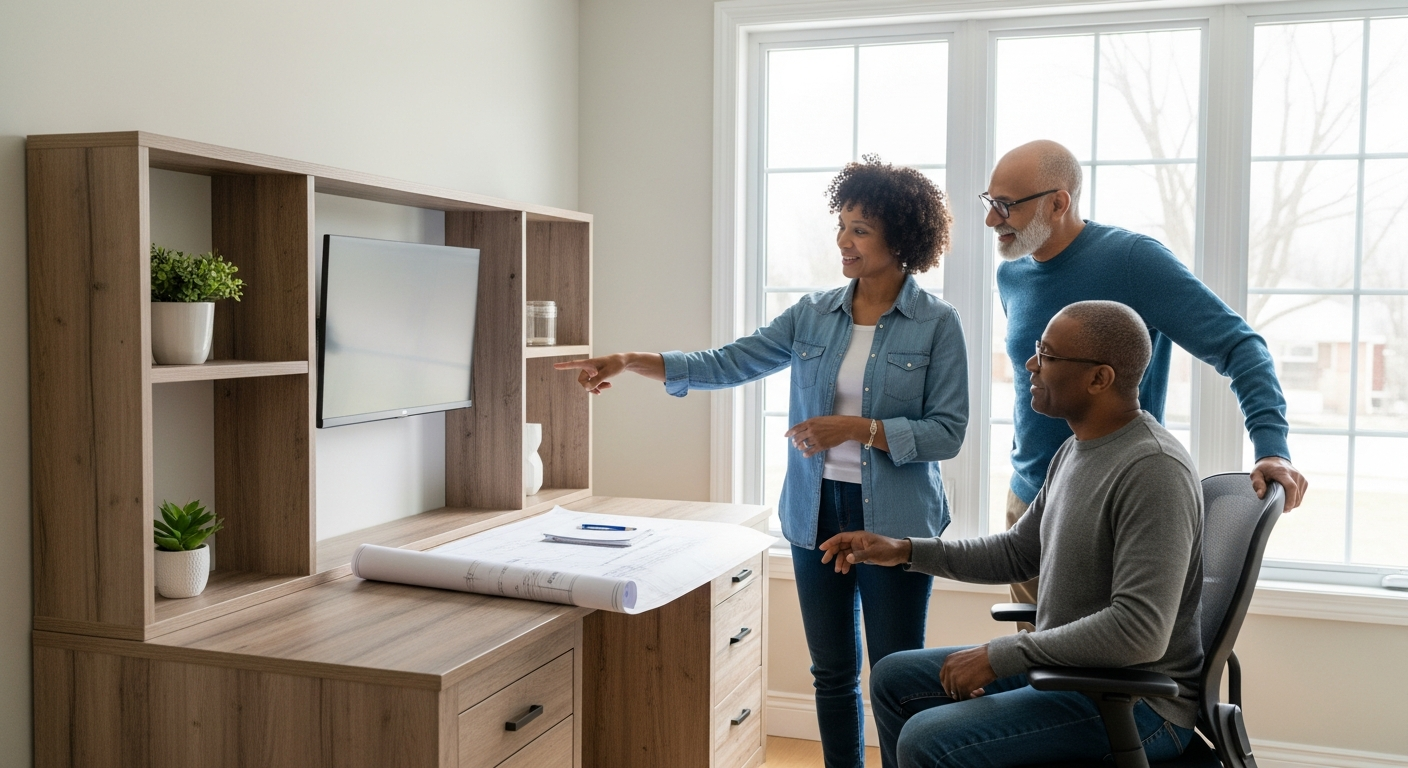
An upgraded home office isn't just about comfort — it directly affects health outcomes for people working into their 60s and 70s.
Ergonomic benefits:
- Proper desk height: Prevents shoulder strain and repetitive stress injury
- Supportive chair: Reduces lower back pain and sciatica
- Monitor height: Eliminates neck strain and upper back tension
- Footrest: Improves circulation; reduces foot/ankle swelling
Lighting benefits:
- Natural light (if possible): Regulates circadian rhythm; improves mood
- Task lighting: Reduces eye strain; improves focus for detail work
- No glare: Prevents headaches and fatigue
Environmental benefits:
- Noise control: Reduces stress; enables focus for complex thinking
- Climate control: Prevents overheating (cognitive decline) or cold (muscle tension)
- Air quality: Fresh air circulation improves oxygen levels; affects cognitive performance
Psychological benefits:
- Professional appearance: Boosts confidence for client calls and video meetings
- Organized space: Reduces mental clutter; enables focus
- Separation from home life: Creates psychological boundary; preserves work-life balance
Studies show that workers age 55+ with ergonomic, well-lit offices report 40% less pain and 25% higher productivity than those in makeshift setups.
Tax and Business Deductions
If you're self-employed or do consulting work, a home office upgrade may be partially tax-deductible.
Deductible expenses:
- Office furniture (desk, chair, shelving)
- Equipment (monitors, keyboard, mouse, printer)
- Professional software licenses
- High-speed internet (pro-rated to home office use)
- Lighting fixtures
Non-deductible:
- General home improvements (flooring, paint, AC if it heats/cools the whole house)
- Furniture and decor not directly tied to work
CRA rules: For a home office to be deductible, it must be:
- Exclusive workspace used for work
- Principal place of business (or regularly used for business)
- Not a guest bedroom that's sometimes used for work
According to the CRA, a reverse mortgage to fund a home office upgrade is generally NOT considered a business loan (therefore not deductible), but the office expenses themselves may be deductible depending on your business structure. Consult an accountant for your specific situation.
Comparison: Reverse Mortgage vs. Other Funding Options
| Funding Source | Cost | Timeline | Impact on Retirement Income |
|---|---|---|---|
| Personal loan | 5–8% interest; $300–$400/month payment for 5 years | Fast approval (1–2 weeks) | Reduces monthly retirement income; must be paid back |
| HELOC | 4–6.5% interest; interest-only payments ($60–$100/month on $15K) | Fast approval; funds available immediately | Ongoing monthly cost; but more flexible than personal loan |
| Reverse mortgage | 5–7% interest; NO monthly payments; interest accrues on balance | Standard approval (4–6 weeks) | No impact on retirement income; interest cost covered by work income |
| Personal savings | 0% cost; immediate access | Instant | Eliminates emergency reserves; high opportunity cost if funds were invested |
| Credit card | 19–21% interest if not paid off | Instant | Extremely costly; not recommended |
For extended work scenarios, a reverse mortgage typically wins because it doesn't create monthly payment burden on your retirement income; your work income naturally services the cost.
Structuring a Reverse Mortgage for Home Office Work
Step 1: Determine total upgrade cost. Get quotes for all components.
Step 2: Choose a draw structure:
- Lump sum: Take all $15,000 at closing; manage your own timeline and spending
- Line of credit: Draw as vendors invoice (e.g., $3,500 for desk/chair, then $2,000 for monitors, etc.); reduces interest costs on unused balance
- Scheduled draws: Monthly amounts over 6–12 months as work progresses
Step 3: Plan repayment timing:
- If your consulting income is seasonal, time the RM drawdown to your busy season
- Plan for RM interest costs to be covered by work income (e.g., extra $200/month revenue = $2,400/year ≈ RM interest cost)
Step 4: Documentation for lender:
- Home office upgrade doesn't require special approval, but mentioning it demonstrates intentional use of funds
- Some lenders ask why you're accessing the RM; "upgrading home office to extend consulting career" is a legitimate, clear answer
FAQ
Will a home office upgrade help me qualify for a reverse mortgage?
Not directly. Qualification is based on age (55+), home equity, and property type — not on how you'll use the funds. However, demonstrating intentional use (extended work, income generation) can support the case for approval.
Can I deduct the reverse mortgage itself as a business expense?
No. The RM is a personal loan. However, the office expenses funded by the RM (desk, monitors, equipment) may be deductible if you're self-employed. Consult an accountant.
How much should I allocate to a home office upgrade?
The sweet spot is typically $12,000–$20,000. This covers a truly professional, ergonomic, technology-enabled workspace without exceeding the ROI threshold.
If I plan to work only 3 more years, is a home office upgrade still worth it?
Maybe not. The RM costs money, and you need work income to justify it. If 3 years of additional income from an upgraded office exceeds the RM cost, yes. Otherwise, consider a personal loan or HELOC.
Can I upgrade my office if I'm already retired (not earning income)?
Yes, but the financial case is weaker. If you're retired and no longer earning, a reverse mortgage to fund a home office doesn't make sense unless you plan to resume work.
What if I upgrade my office and then decide not to work?
The upgrade cost is sunk (you're still responsible for RM repayment). It becomes a general home improvement. Avoid this by being committed to extended work before upgrading.
Take Action
If you're 55+ and envision working 10+ more years in a consulting, freelance, or part-time capacity, a home office upgrade funded by a reverse mortgage is a smart investment in both productivity and health. Talk with Rick Sekhon Reverse Mortgages about structuring a RM to fund your office upgrade, with draw timing aligned to your work calendar.
Ready to Learn More?
Get the free Ontario Reverse Mortgage Guide and find out exactly how much you could unlock from your home.
Get My Free Guide →Related Articles
Reverse Mortgage for Active Retirement (Age 55–65): Funding Travel and Lifestyle
Early retirees (55–65) face a unique challenge: long lifespan, high lifestyle costs, portfolio longevity. Learn how a reverse mortgage can fund active retirement adventures without portfolio depletion.
Read →Reverse Mortgage to Fund Volunteer Transition: Purpose-Driven Retirement
Use a reverse mortgage to fund training and transition for meaningful volunteer work in retirement. Turn purpose into a paid leave from work.
Read →Reverse Mortgage for Workplace Injury Recovery: Supporting Adult Child's Career Transition
Help your adult child rebuild their career after workplace injury. Learn how reverse mortgages fund recovery, retraining, and financial stability during career transition.
Read →