
How Reverse Mortgage Appraisals Work in Ontario
Complete guide to the reverse mortgage appraisal Ontario process: costs, preparation tips, what appraisers evaluate, and how your home's value determines borrowing limits.
"My broker says I need an appraisal before my reverse mortgage can move forward — what exactly does that involve, and can I do anything to improve the result?" The home appraisal is one of the most important steps in the reverse mortgage process, yet it is also one of the least understood. This guide explains exactly how the reverse mortgage appraisal works in Ontario, what it costs, what the appraiser evaluates, and how to prepare so your home is valued fairly.
This article is for educational purposes only and does not constitute financial advice.

What Is a Reverse Mortgage Appraisal and Why Is It Required?
A reverse mortgage appraisal is a professional assessment of your home's current fair market value, conducted by a certified appraiser who is a member of the Appraisal Institute of Canada (AIC). Under Canadian regulations, federally regulated lenders must obtain an independent property valuation before advancing any mortgage funds — reverse mortgages included.
The appraisal serves two purposes:
- It protects you. The lender cannot lend more than a safe percentage of your home's value, ensuring you retain meaningful equity.
- It protects the lender. The property is the sole security for a reverse mortgage. There are no monthly payments, so the lender needs confidence that the property value supports the loan.
The Financial Consumer Agency of Canada (FCAC) requires that all reverse mortgage borrowers understand how the appraised value of their home directly determines the amount they can borrow. The Office of the Superintendent of Financial Institutions (OSFI) sets the lending guidelines that federally regulated institutions follow when underwriting reverse mortgages, including appraisal standards.
If you are still confirming whether you qualify for a reverse mortgage, review the full requirements at reverse mortgage eligibility in Ontario.
Who Pays for the Appraisal — and What Does It Cost?
The borrower pays for the appraisal. This is a standard closing cost that applies to every reverse mortgage application in Ontario. Rick Sekhon will explain all costs upfront during your initial consultation so there are no surprises.
| Cost Item | Typical Range | Notes |
|---|---|---|
| Standard freehold appraisal | $300–$450 | Single-family detached, semi-detached, townhouse |
| Condo appraisal | $300–$400 | May be slightly lower due to comparable data availability |
| Rural or waterfront property | $400–$500+ | Higher due to limited comparables and travel time |
| Second appraisal (if disputing) | $300–$500 | Paid by borrower; not guaranteed to change outcome |
| Desktop appraisal (if accepted) | $100–$200 | Not available from all lenders or for all properties |
For a complete breakdown of every fee involved in the process, see the full guide to reverse mortgage fees and costs in Ontario.
What Does the Appraiser Evaluate?
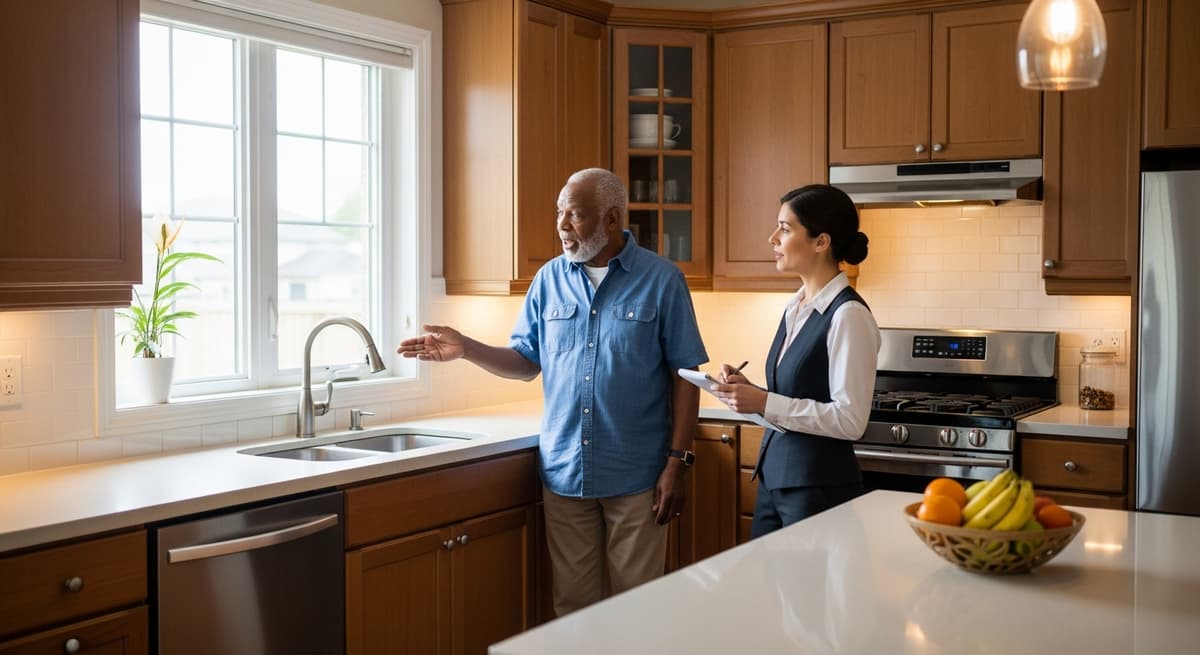
The appraiser's job is to determine your home's fair market value based on its physical characteristics, condition, and how it compares to recently sold properties in your area. Here is what they assess during the visit:
Property Size and Layout
The appraiser measures the total living area (above-grade square footage), lot size, number of bedrooms and bathrooms, and overall layout. Finished basements add value but are typically calculated separately from above-grade space.
Condition and Maintenance
The appraiser notes the general condition of the roof, foundation, windows, HVAC system, plumbing, and electrical. They are not conducting a home inspection — they will not test systems or look behind walls. However, visible signs of deferred maintenance (peeling paint, water stains, damaged flooring) will negatively affect the valuation.
Location and Neighbourhood
Location is one of the strongest value drivers. The appraiser considers proximity to amenities, school quality, transit access, neighbourhood desirability, and local market trends. A well-maintained home in a strong neighbourhood will appraise higher than an identical home in a weaker market.
Comparable Sales (Comps)
The appraiser identifies 3–5 recently sold properties that are similar to yours in size, age, condition, and location. These "comparables" form the foundation of the valuation. The appraiser adjusts for differences — for example, adding value if your home has a garage and the comparable did not, or subtracting if the comparable had a renovated kitchen and yours does not.
Appraisal Factors and Their Impact on Value
| Factor | Impact Level | What Increases Value | What Decreases Value |
|---|---|---|---|
| Location and neighbourhood | High | Desirable area, transit access, low crime | Remote location, industrial proximity |
| Square footage (above-grade) | High | Larger living area, open layout | Small or awkward layout |
| Lot size | Medium–High | Larger lot, private yard | Small lot, shared driveway |
| Kitchen and bathroom condition | Medium–High | Updated finishes, modern appliances | Dated fixtures, poor condition |
| Roof and structural condition | Medium | Recent replacement, no visible issues | Aging roof, foundation cracks |
| Finished basement | Medium | Legal suite potential, additional living space | Unfinished, low ceiling height |
| Curb appeal and landscaping | Low–Medium | Well-maintained exterior, mature trees | Overgrown yard, damaged siding |
| Garage or parking | Low–Medium | Attached garage, private driveway | Street parking only |
| Recent renovations | Medium | Permits on file, quality workmanship | Unpermitted work, poor quality |
How Appraisal Value Affects Your Borrowing Amount
Your appraised home value is the starting point for calculating how much you can borrow through a reverse mortgage. Canadian lenders — including HomeEquity Bank (CHIP), Equitable Bank, and Bloom Financial — typically allow borrowers to access up to 55% of their home's appraised value, depending on several factors.
| Borrower Age | Approximate Maximum LTV | Example: Home Appraised at $700,000 |
|---|---|---|
| 55–59 | Up to 15–20% | $105,000–$140,000 |
| 60–64 | Up to 20–30% | $140,000–$210,000 |
| 65–69 | Up to 25–35% | $175,000–$245,000 |
| 70–74 | Up to 30–40% | $210,000–$280,000 |
| 75–79 | Up to 35–45% | $245,000–$315,000 |
| 80+ | Up to 40–55% | $280,000–$385,000 |
LTV = Loan-to-Value. Percentages are approximate and vary by lender, property type, and location.
The formula is straightforward: a higher appraisal means a higher potential borrowing limit. This is why preparing your home for the appraisal is worth the effort.
For a detailed comparison of what each lender offers, see CHIP vs Equitable Bank in Ontario.
Desktop vs In-Person Appraisals
There are two types of appraisals used in the reverse mortgage process:
In-Person (Full) Appraisal
This is the standard approach. A certified appraiser visits your property, conducts a physical inspection, takes photographs, and prepares a detailed report. The visit typically takes 30–90 minutes.
- ✓ Most accurate valuation method
- ✓ Accepted by all lenders for all property types
- ✓ Appraiser can identify positive features that data alone would miss
- ✗ Costs $300–$500
- ✗ Requires scheduling and home access
- ✗ Takes 7–14 days from order to completed report
Desktop Appraisal
A desktop appraisal uses property data, tax assessments, MLS records, and automated valuation models to estimate value without a physical visit. Some lenders accept desktop appraisals for straightforward properties in data-rich urban markets.
- ✓ Lower cost ($100–$200)
- ✓ Faster turnaround (2–5 days)
- ✓ No need to prepare or be home
- ✗ Not accepted by all lenders
- ✗ Not available for rural, unique, or high-value properties
- ✗ May undervalue properties with recent upgrades not yet reflected in data
Rick Sekhon Reverse Mortgages can advise whether a desktop appraisal is an option for your specific property and lender combination.
How to Prepare Your Home for the Appraisal
You cannot change your home's location or square footage, but you can ensure the appraiser sees your property at its best. These steps are practical, low-cost, and can make a meaningful difference:
Before the Appraisal Visit
- Declutter all rooms. Clear countertops, remove excess furniture, and organize closets. A tidy home appears larger and better maintained.
- Clean thoroughly. A clean home signals that the property has been well cared for.
- Complete minor repairs. Fix leaky faucets, replace burned-out lightbulbs, patch small holes in walls, and repair any broken fixtures.
- Improve curb appeal. Mow the lawn, trim hedges, clear the walkway, and ensure the front entrance is presentable.
- Ensure all areas are accessible. The appraiser needs to see the basement, attic access, garage, and all rooms. Unlock all doors and clear any blocked areas.
Documentation to Have Ready
Prepare a list of any upgrades or renovations completed in the past 10 years, including:
- Roof replacement (with date and contractor)
- Kitchen or bathroom renovations
- Window or door replacement
- HVAC system upgrades
- Electrical panel upgrades
- Permits obtained for any work
Providing this information to the appraiser ensures that improvements are captured in the report. The Municipal Property Assessment Corporation (MPAC) may not have updated records for recent renovations, so your documentation fills that gap.
What Happens If the Appraisal Comes in Lower Than Expected?
A lower-than-expected appraisal is disappointing but not uncommon. Here are your options:
- Accept the lower value and proceed. Your borrowing limit will be reduced proportionally. If you still receive enough funds for your needs, this may be the simplest path forward.
- Request a reconsideration of value. If you believe the appraiser missed key information — such as recent renovations or incorrect comparable sales — you can ask Rick Sekhon to submit additional evidence to the appraiser for review. This is not a formal dispute; it is a request to reconsider based on new data.
- Order a second appraisal. Some lenders allow a second independent appraisal at your expense. The second appraisal must also be from an AIC-certified appraiser. There is no guarantee the second value will be higher.
- Withdraw the application. You are not obligated to proceed. However, the appraisal fee is non-refundable.
| Scenario | Likely Outcome | Cost to Borrower |
|---|---|---|
| Appraisal matches expectations | Proceed as planned | Standard appraisal fee only |
| Appraisal 5–10% below expected | Reduced borrowing limit; may still meet needs | Standard appraisal fee only |
| Appraisal significantly below expected | May not meet borrowing needs | Standard fee + possible second appraisal fee |
| Reconsideration with new evidence | Value may be adjusted upward | No additional cost |
| Second appraisal ordered | New value used (higher or lower) | $300–$500 additional |
How Long Does the Appraisal Take?
The appraisal is typically the longest single step in the reverse mortgage process. Here is the breakdown:
- Scheduling the appraiser: 3–7 days in urban Ontario (Toronto, Ottawa, Hamilton, Kitchener-Waterloo); 7–14 days in rural or northern Ontario
- The on-site visit: 30–90 minutes
- Report preparation and delivery: 3–5 business days after the visit
Total typical timeline: 7–14 days in urban areas, 14–21 days in rural areas.
If you are working on a tight timeline, this is one of the stages where advance planning helps most. For the full application timeline, see how long a reverse mortgage takes in Ontario.
Homeowners exploring reverse mortgages to fund aging in place or to improve retirement cash flow should factor the appraisal timeline into their planning.
Tips to Maximize Your Appraisal Value
Beyond the preparation steps above, these strategies can help ensure your home is valued fairly:
- Time your application strategically. If you have a renovation in progress, complete it before the appraisal. An unfinished project can lower the value.
- Research recent sales in your area. Check what comparable homes have sold for on realtor.ca or housesigma.com. This gives you a realistic expectation and helps you identify if the appraisal seems off.
- Highlight energy efficiency upgrades. New windows, insulation, high-efficiency furnaces, and solar panels are increasingly valued by appraisers.
- Address any safety concerns. Missing handrails, broken steps, or exposed wiring will be noted and can reduce the valuation.
- Keep property tax payments current. While this does not directly affect the appraisal, lenders verify property tax status as part of the approval process.
FAQ
Do I get to choose the appraiser? No. The lender orders the appraisal from an independent, AIC-certified appraiser. This ensures objectivity. Neither you nor your broker selects the specific appraiser. However, the appraiser must be licensed and in good standing with the Appraisal Institute of Canada.
Can I use a recent appraisal I already have? Generally, no. Reverse mortgage lenders require a current appraisal ordered through their own process. An appraisal you obtained independently — even if recent — will typically not be accepted because the lender needs to verify the appraiser's credentials and ensure the report meets their specific requirements.
Is the MPAC assessment the same as an appraisal? No. The Municipal Property Assessment Corporation (MPAC) assessment is used for property tax purposes and is often significantly different from fair market value. MPAC assessments in Ontario are based on a valuation date that may be several years old. A professional appraisal reflects current market conditions and is far more accurate for lending purposes.
What if my home needs significant repairs — will I be declined? Not necessarily. The appraisal will note the condition of the property, and the lender will factor this into their decision. Minor deferred maintenance is common and generally acceptable. However, if the property has major structural issues, active water damage, or health hazards (such as mould or knob-and-tube wiring), the lender may require repairs before proceeding or may decline the application.
Does the appraiser go into every room? Yes, the appraiser will typically need to see every room, including the basement, attic access, bathrooms, and garage. They photograph key areas for the report. If a room is inaccessible, the appraiser may note this as a limitation, which could affect the valuation.
Will improvements I made without permits affect the appraisal? Unpermitted work presents a risk. The appraiser may note visible additions or renovations that do not appear in municipal records. While the appraiser still considers the improvements in the valuation, the lender may have concerns about unpermitted structural changes. Having permits on file for major work is always preferable.
Speak to a licensed mortgage professional. Independent legal advice is required before closing a reverse mortgage in Ontario.
Get your free Ontario Reverse Mortgage Guide →
This content is for illustrative purposes only. Rates may vary. Call Rick Sekhon for the best rates and more information.
Ready to Learn More?
Get the free Ontario Reverse Mortgage Guide and find out exactly how much you could unlock from your home.
Get My Free Guide →Related Articles
Reverse Mortgage Fees in Ontario: Every Cost Explained (2026)
Full breakdown of every cost involved in an Ontario reverse mortgage: setup fees, appraisal, legal fees, title insurance, and ongoing costs. No surprises.
Read →Reverse Mortgage Eligibility in Ontario: Complete 2026 Guide
Everything Ontario homeowners need to know about qualifying for a reverse mortgage in 2026. Covers age requirements, home equity, property types, and the application process.
Read →How Long Does It Take to Get a Reverse Mortgage in Ontario? (2026)
Full timeline for getting a reverse mortgage in Ontario: from application to funding. Every step explained with realistic time estimates and what causes delays.
Read →